|
|
|
|
|
Newsletter November 14, 2023
|
|
UK - Helping you and your calves breathe easy this winter
AHDB is hosting a series of calf pneumonia webinars this November featuring industry experts and farmers to help you learn how to prevent the disease, reduce costs and lessen the impact on your teams.
Pneumonia is the leading cause of calf deaths on dairy and beef farms, and the increased effort, veterinary care and lower growth rates can be disheartening for you and your teams. Not only that, it affects your bottom line as each incident can cost up to £500 per animal, and treatment plays a significant role in the use of antibiotics on-farm.
You'll learn about everything you need to prevent and treat pneumonia - from housing and stress management to vaccinations and painkillers - to stop it happening in the first place, reduce your costs and help you breathe easier this winter. The first 200 levy payers to register can choose to receive a delegate pack containing a thermometer, calf thermometer, new calf housing guide, and calf health scorecard. We'll even send you a cuppa and biscuit to enjoy while you watch our webinars.
Other webinar details to follow
- Tuesday 14 November, 7:00-8:30pm - The role of housing in calf pneumonia prevention
- Wednesday 15 November, 12-1pm - How to provide the perfect ambient environment for calves
- Friday 17 November, 12:00-1:30pm - Managing stress and the use of vaccines for pneumonia control in calves
- Tuesday 21 November, 7:00pm - Calf pneumonia: Antimicrobials and NSAIDs
- Wednesday 22 November, 7:00-8:30pm - Post-mortem and lung scoring
- Thursday 23 November - Tackling pneumonia: One farm's approach
Find out more at ahdb.org.uk/helping-you-and-your-calves-breathe-easy-this-winter
AHDB
|
|
|
|
|
UK - Consider supplementing to prevent mycotoxicosis
Mycotoxins can be invisible in feed, and they could be doing harm to the dairy herd. In the November edition of British Dairying, you can find out what producers can do to reduce the impact.
Weeks of wet and often humid conditions in the run up to and during harvest have encouraged various moulds or fungi which produce performance impacting mycotoxins. "Those conditions are reflected in the trends from the forage samples we've received for testing so far this season," says Agri-King's Nutritionist, Grace Thomas. "The early indicators are towards higher toxin levels compared to last year's forages. We have also started to see toxins in straw.
"Hundreds of known mycotoxins exist, and they can be formed in the field, in storage or both. While some moulds are clearly apparent on the cereal and maize haulm, others are microscopic, and invisible to the eye. However, hundreds of known mycotoxins exist, and they can be formed in the field, in storage or both," she explains.
"If cattle are fed cereal and maize silage contaminated with mycotoxins, then rumen microbes, in particular protozoa, are able to reduce some mycotoxins' toxicity. However, others can cause mycotoxicosis which can have a negative effect on the rumen flora and in turn impact on yield, health and fertility."
Mycotoxicosis: What to look out for - Reduced feed intake or feed refusals; intermittent diarrhoea and/or inconsistent manure due to gut irritation and/or inflammation; reduced growth, performance, or immune function; irregular heats, reduced reproductive performance and precocious puberty; all due to the mycotoxin, zearalenone, which has a chemical structure very similar to the hormone oestrogen.
Dairy animals are more sensitive to mycotoxins than beef cattle because they have higher feed intakes and faster digestive rates, giving less time for the mycotoxins to degrade in the rumen.
Read the full story in the November edition of British Dairying
|
|
|
|
|
Global - Learning from farmers around the globe at the IDF World Dairy Summit
The NFU dairy team and National Dairy Board Chairman Michael Oakes recently joined almost 1,200 delegates from 50 countries at the 2023 International Dairy Federation's World Dairy Summit in Chicago.
The summit, entitled 'Boundless Potential, Endless Possibilities', featured more than 100 speakers from across the global industry, including US Secretary for Agriculture Tom Vilsack, the CEOs of top dairy companies from countries such as New Zealand, Japan and India, scientists, economists and of course dairy producers.
The NFU team met up with farmers from around the world to discuss common challenges, share learning and identify ways we can work together in the future to the benefit of the wider industry. Sessions ranged from economic and trade outlooks to looking in detail at precision nutrition, investment potential, how to accelerate profitable sustainability for farmers, managing welfare and more.
Away from the buzz of the main conference, the USA National Milk Producers Federation hosted a roundtable discussion for young farmers where representatives from more than 10 countries came together to discuss the future outlook for the sector. The session was chaired by Krysta Harden, the former United States Deputy Secretary of Agriculture, and featured a panel of speakers with the UK represented by NFU Midlands member, Nuffield Scholar and dairy farmer Ruth Grice.
Read more
|
|
|
UK - Let's chat about calves

Rearing calves? Whether dairy replacements or beef from dairy, calf health and managing calves for optimal performance is key - and it all comes down to attention to detail:
- Cleanliness - in the calving pen, milk prep area and feeding/drinking equipment
- Colostrum - quality and intake
- Feeding - milk replacer and concentrate feed + roughage
- Measure, monitor and review your performance
@CalfChat is delighted to be launching a new website which is a collection of best practice information, technical resources, practical hints and tips; find out more.
Why not sign up to @CalfChat to find out more - the first 50 people to register will receive a free @CalfChat beanie.
Look out for @CalfChat on social media too, there's regular technical updates, live Q&A sessions and polls.
|
|
|
UK - Sector Council appointments ratified by levy payers
Twenty new appointments and re-appointments have been made to AHDB's Sector Councils in the Beef and Lamb, Cereals and Oilseeds, Dairy and Pork sectors, following the completion of the ratification process. This process was run by an independent organisation - Civica Election Services Limited - which reported that 1,586 levy payers voted out of a total registered of 9,228. No candidate received less than two thirds of the available votes.
Sector Council members were selected on an open, competitive, skills-based process before levy payers, who were registered to vote, were asked if they agreed with the recommended appointments via a yes/no vote. The Sector Councils represent the voice of levy payers in the heart of AHDB, deciding which programmes of work are needed to support their sectors, as well as recommending the levy rates needed to fund them.
Dairy appointments include: Lyndon Edwards; David Craven (Dairy Farmer); Colin Ferguson; Andrew Fletcher (Dairy Farmer); Liz Haines (Dairy Farmer); Ian Harvey (Dairy Farmer); Mike King (Dairy Farmer); Patrick Morris-Eyton; Rob Nancekivell (Dairy Farmer); Scott Shearlaw (Dairy Farmer); Peter Rees (Dairy Farmer); Gemma Smale-Rowland (Dairy Farmer); Joe Towers
Full list of the appointments here AHDB Dairy Sector Council | AHDB
AHDB
|
|
|
NEW: Merlo Turbofarmer 27.6 set to debut at AgriScot
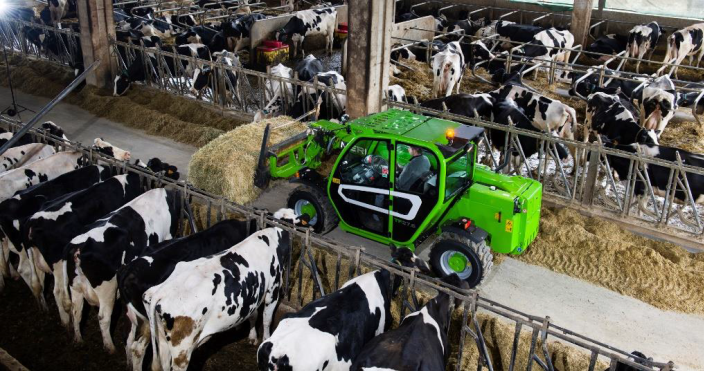
Merlo is pleased to announce the introduction of a new model, the Turbofarmer 27.6. This new model represents the ideal compromise between size and power, with compact dimensions whilst still offering excellent performance, say Merlo.
Specifically designed and built for the agricultural market, the TF27.6 offers several new features including an enhanced hydraulic system with flow sharing control offering hydraulic flow to 95l/min ensuring the possibility of operating up to three hydraulic movements simultaneously. A new high torque hydrostatic driveline transmission has been developed with a 150cc oversized hydrostatic engine, allowing the machine to reach a maximum road speed of 40km/h.
The TF27.6 has an impressive lifting capacity of 2.7 tonnes with a 6-meter reach and measures at 2.2m tall & 1.9m wide. Despite its compact size, the TF27.6 is also equipped with a full-size Merlo ROPS & FOPS equipped cab, as found across the Merlo handler range. Enhanced load control system provides precise feedback of load position and safety stability of the machine ensuring maximum lifting performance.
Equipped with a new triggerless capacitive multifunction ergonomic joystick, these new models can also be fitted as option with the proven Merlo Adaptive Stability Control System (ASCS) which offers an in cab LCD display with attachment recognition and weighing system.
The company has been supplying the Merlo dealer network and its British customers with telescopic handlers since 1993. Continued investments in the UK include a fully stocked Merlo parts warehouse offering next day parts delivery to the Merlo dealer network. With industry leading technical training facilities ensure a high degree of specialist knowledge is available to offer the best possible aftersales support to dealers and customers nationwide.
AgriScot 2023 will see the launch of the brand-new Merlo Turbofarmer 27.6. See us on stand 142 in the Highland Hall where you can be among the first to view the new machine.
Merlo
|
|
|
UK - Joining forces sees new digital technology get real on farm
An industry collaboration led by national dairy co-operative First Milk has brought digital innovation to its members' farms in Cumbria and South West Scotland.
Part of the Digital Dairy Chain, a UK Research & Innovation-funded project, this first-of-a-kind 'Digitalisation Demonstrator' is highlighting how joining forces across the industry is bringing innovation-led growth to improve supply chain efficiency. Managing the project, First Milk's Toni Bruce commented: "Our members are always looking for the better way by embracing new technology on their farms.
"Our interest in the Genocells technology came initially from looking at improved welfare as a component of farm sustainability but it supports a range of herd management decisions from infection control to breeding plans. Greater insight into an individual cow's genetic potential can improve feed use efficiency and reduce environmental impact. We are delighted to be a project partner and ultimately benefiting the wider dairy industry."
First Milk members are the first British farmers to use the 'Genocells' technology to report individual somatic cell counts from a single bulk milk sample using genomic information of the cows in the herd. Using genetics to target important traits is central to First Milk member Fraser Purdie's herd management. So, not surprisingly, he was attracted to the technology by the dual benefits of individual somatic cell counts and breeding potential derived from its genomic data.
He is particularly impressed with its accuracy: "From the very first month, I knew I was onto something when the lab phoned to find out why a specific cow's milk was missing from the tank! And the tests have continued to improve. Last month, for example, the top 20 cows for cell counts listed on both the Genocells data and conventional milk recording were identical. Once I've studied all the data-recording systems fully, I'm keen to use Genocells alone."
The Genocells technology has been brought to the UK from France under licence by collaboration partners NMR. Other organisations participating in the Digital Dairy Chain project are Lactalis UK & Ireland and Scotland's Rural College (SRUC). Lactalis UK & Ireland is continuing to secure additional participants from a wide range of farming systems, while SRUC supports the data evaluation.
|
|
|
BouMatic launch first ICAR approved wireless milk meter - The MagStream Milkmeter
The new MagStream Milk meter ensures a continuous and completely free milk and air flow and has the lowest occurrence of vacuum drops and fluctuations of any meter of the market today, say Boumatic.
Thanks to advanced technologies used for power management, data communication and recording, it is the first milk meter that is completely wireless.
Key Features of the MagStream Milkmeter:
Easy Installation & Service: The MagStream Milkmeter's wireless design ensures easy installation and service. It is plug-and-play, quickly calibrated (statistically) and can be fully integrated with your milking installation, farm automation systems and herd management software programs.
Animal Friendly: With its 100% free-flow design, the MagStream Milkmeter guarantees a stable vacuum and a very low vacuum drop throughout the milking process, providing optimal comfort for the animals and resulting in consistently efficient milking sessions.
ICAR Approved: The MagStream Milkmeter is ICAR approved, ensuring top performance when it comes to accuracy, hygiene and more.
Boumatic
|
|
| |
| |
|
|
|
Farming Connect helps student land a job
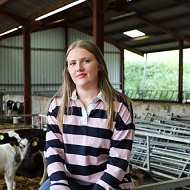
After hearing of a vacancy while undertaking one of two residential study visits, a young North Wales student has secured a role as a herdperson on a 700-cow herd on the Llyn Peninsula. One visit in North Wales and the other in the Netherlands, were part of her placement on the Wales Farming Connect Agri Academy. Lea Williams, who grew up on a beef and sheep farm in Denbighshire and had completed her course in agriculture at Glynllifon College, said the study visits broadened her knowledge and outlook on agriculture. Lea hopes to one day run her own business, and said the knowledge she gained on the Agri Academy Junior Programme has been invaluable. BusinessWales.gov.wales
|
|
|
|
|
|
Managing dry cows
Managing dry cows and their transition period successfully is the foundation for lactation success. Using your farm's existing herd management software, Predicta GUARDIAN analyses the milk recording or milk meter data along with reproduction from a cow's previous lactation to determine whether a cow is at risk for transition diseases(s). Predicta GUARDIAN generates alarms to farmers/vets directly via whatsapp for individual animals at risk during the dry period 6-8 weeks prior to the actual disease. Try it for yourself in a free no commitment trial Get started
|
|
|
|
|
|
King's speech benefits for exports
Dairy farmers were told they will benefit from reduced tariffs on cheese and butter exports to Canada, Chile, Japan and Mexico under The Trade (Comprehensive and Progressive Agreement for Trans-Pacific Partnership) Bill. The Government said the agreement would deliver new export opportunities for UK farmers while safeguarding UK food safety standards. The Government's Animal Welfare (Livestock Exports) Bill would ban the export of cattle, sheep, goats, pigs and horses for slaughter and fattening from Great Britain. The Government said the Bill would 'stop unnecessary stress, exhaustion and injury caused by exporting live animals' on long journeys for slaughter and fattening. Read more
|
|
BRITISH DAIRYING
ENSURE YOU RECEIVE EVERY COPY
British Dairying is available by subscription at £70.00 posted to UK addresses,
£90.00 for Europe, £115.00 for the Rest of the world
or £30 +VAT for British Dairying Online only
|
|
| |
QUOTE
"It was only a sunny smile, and little it cost in the giving, but like morning light it scattered the night, and made the day worth living."
F Scott Fitzgerald
|
|
| |
|
|
|
You are receiving this email because you are a registered reader of British Dairying and we are pleased to send you extra information to supplement the journal.
|
|
|
|
|
British Dairying,
WB Publishing Ltd
Priory Cottage, Eastbourne Road Ridgewood East Sussex TN22 5ST
WB Publishing Ltd is registered in England and Wales, Registration No 2951727
|
|