|
|  |
|
May 5, 2026
|
|
Europe - EU farmers and hauliers to get up to 50,000 Euros to cover extra costs of Iran war
The EU is to subsidise up to 70% of the extra cost of fuel and fertilisers caused by the Iran war for farmers, fishing businesses and road hauliers as part of a package of emergency measures.
Individual companies can claim up to EUR50,000 each between now and the end of the year with minimum paperwork, a measure the EU hopes will remove what it sees as an existential threat to hauliers and farmers. Energy-intensive industries including steel, chemicals or even rail firms, will be able to claim up to 70% of the extra electricity cost of eligible consumption.
Announcing the measures, the European Commission Vice-President, Teresa Ribera, said they could be the difference between "survival or giving up" for many businesses. "I want to reassure European citizens, national governments and European institutions are monitoring and are ready to react in cases when it is needed," she said.
Oil and gas prices surged during the US-Israeli war against Iran that began in February, with fertiliser prices shooting up by 61% in March alone after supplies of urea and fuel were choked off by the blockage of the strait of Hormuz.
The EU said the loosening of state aid rules was an emergency measure aimed at helping those in agriculture and fisheries, including aquaculture, as well as transport - covering road, rail and inland waterways, plus intra-EU short sea shipping. No relief has been offered to airlines and airports regarding jet fuel, but potential future intervention has not been ruled out.
Individual member states can configure the state aid they offer businesses according to local conditions, but small hauliers, farmers and fishers will be able to claim the fixed amount of up to EUR50,000, with minimal fuss.
www.theguardian.com/world/2026/apr/29/eu-farmers-hauliers-fishing-subsidies-up-to-50000-fuel-fertiliser-iran-war
|
|
|
|
|
UK - 60% of woodland owners unlikely to create new wooded areas due to IHT changes
A survey of UK woodland owners, estate managers and land agents has revealed that recent changes to Inheritance Tax (IHT) make 60% of respondents less likely to invest in creating new woodland.
Only around one third believe they will not be impacted by the changes, with almost half expecting to be affected and others remaining uncertain.
The Confederation of Forest Industries (Confor), the Country Land and Business Association (CLA) and the Royal Forestry Society (RFS) conducted the survey to better understand how the April 2026 changes to Agricultural Property Relief (APR) and Business Property Relief (BPR) may affect woodland owners, forestry businesses and mixed estates in practice. The results illustrate that family-owned woodland and mixed estates may be at particular risk, with many considering earlier timber harvesting, selling woodland, altering succession arrangements or reducing future investment in woodland management.
Gavin Lane, CLA President, said: "A drop in tree planting, earlier felling, land sales - these are the warnings from the UK's forestry sector, as woodlands risk becoming unintended casualties of the government's inheritance tax changes. We know these reforms are hurting family-owned businesses across the UK, but their impact on forestry has received far less attention.
"The government has legally binding environmental targets and ambitions to accelerate tree planting. This evidence suggests those goals are now in danger, undermining the sector and the investment made to date.
We are ready to work with Government on solutions to prevent undoing the progress on environmental and tree cover targets which our survey shows will result from the IHT changes."
The survey attracted 204 responses from across the UK. The evidence collected suggests the changes to IHT will potentially impact timber supply, carbon storage, nature recovery and continuous cover forestry on a national scale. www.cla.org.uk
|
|
|
Ukraine - Country is facing mass closure of dairy farms
In Ukraine, there is already a gradual reduction in the number of cows, while the export of cattle abroad is increasing.
Dairy farms are operating at a loss and will start closing en masse closer to summer, with the situation in the industry potentially becoming critical in the Autumn. This was reported by the Deputy General Director of the Association of Milk Producers Olena Zhupinas.
"We will see a mass reduction in the number of cows and farm closures no earlier than May-June, when the feed for 2025 runs out. With the high cost of field work in 2026, farmers will decide not to sow fodder crops but to reduce the number of cows," Zhupinas said. So far, there has been no significant reduction in dairy farms, as dairy farmers continue to use old feed stocks.
"As of now, the situation in the industry remains the same as at the end of February, before the war in Iran. But by autumn, the milk production situation may become critical," the expert notes.
The effect of rising energy and fertilizer prices due to Trump's war in the Middle East will be felt by dairy farmers in about a month. "If at the current price of feed, which was grown when diesel was half the price and fertilizers were much cheaper, the price of milk from farms does not cover the cost of its production. It will increase by 20-25%, at least," Zhupinas predicts.
Most farmers will decide whether to take the risk and stay in this business in anticipation of better prices for their products or to exit it, the specialist says. "The market for finished products does not show recovery. Milk processing plants will not be ready to buy milk at an even higher cost, as prices for finished products remain low due to milk overproduction in Europe and the USA," she concludes.
agronews.ua/en/news/ukraine-is-facing-mass-closure-of-dairy-farms/
|
|
|
|
|
Uk - Review milk replacer feed volumes & fat levels to make efficiency gains
 Calf rearers looking to make strategic efficiency gains in-light of lower milk price could benefit from reviewing calf milk replacer feeding volumes and fat levels.
Dr Jessica Cooke, R&D Manager at Feed For Growth (Volac Milk Replacers Limited), says tighter margins underline the importance of cost-effective calf growth. However, they should not be a reason to cut corners in the rearing stage or be tempted to feed whole milk to calves.
"It's always worth investing in calf growth, whatever the milk price," she explains. "Ultimately, you're investing in your herd's future. If you cut back now, you're not making the most of high feed conversion efficiency during the milk feeding stage."
However, she believes there is potential to be more cost efficient and boost performance by thinking about fat inclusion levels in calf milk replacers (CMR) and feeding volumes. Milk replacers of over 22 to 23% fat will likely cost more and can suppress starter intakes, which could have a detrimental impact on long-term performance.
Dr Cooke explains: "Feeding a CMR with a fat content of less than 22% typically stimulates the earlier consumption of solid feed. This is what you want because solid feed intakes pre-weaning stimulates rumen development, which is key to ensuring a smooth transition around weaning. Heifers with good rumen development will continue to grow well immediately post weaning which is an economical stage to grow heifers due to the lower cost of dry feed."
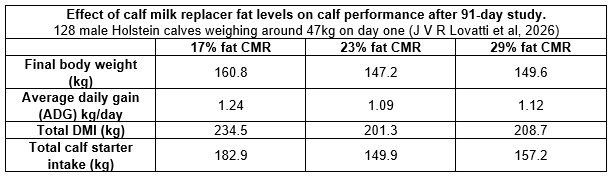
A recent Canadian study found that average daily liveweight gain was greater over a 91-day period for calves fed a 17% fat CMR, versus a 23% and 29% fat CMR. The CMR was a blend of 20% coconut and 80% palm fat at 26% crude protein. There were 128 male Holstein calves enrolled in the study.
Calves fed the 17% fat CMR had higher starter intakes pre and post weaning and consumed 33kg more starter by the end of the study compared to the 23% fat group. Average daily gain was also higher meaning their final body weight was 13.6kg more (see table). This improved performance is likely driven by increased nutrient intake from greater solid feed consumption, particularly post weaning.
Dr Cooke says it's important to get the balance of milk and starter feed right. "Too much fat in your milk replacer in combination with high CMR feeding levels of around 90kg per calf adds cost to your system. It may mean your calves grow well and look amazing to begin with, but immediately post weaning, growth rates will likely crash because calves haven't eaten enough starter. The research suggests feeding 50-60kg of milk solids across the rearing period is the optimum."
Dr Cooke believes thinking about fat levels and feeding rates is an easy win for improving efficiencies without increasing costs. It also acts as a much safer route than looking to lower costs by feeding whole milk to calves in-light of lower milk prices, which could inadvertently introduce diseases like Johne's, Bovine TB and Mycoplasma bovis.
"A quality CMR is not only more hygienic but also has a more consistent macro and micro-nutrient supply for calves than whole milk and can provide additional health package benefits," she adds.
|
|
|
UK - Organic Dairy Round Table event - 9th June at Keythorpe Farms
The Organic Dairy Round Table is hosting an open day on the farm of Wil Armitage, at Keythorpe Farms on the 9th June. All dairy farmers are invited - not just organic ones - as there are transferable skills and knowledge from organic to the conventional sector.
The Organic Round table was formed in summer 2024 following a particularly challenging year for organic production. Since then, the group has met three times a year and has developed into a strong network of industry specialists - including milk processors, feed compounders, certifiers, and farmers. In 2025, the group was formalised with elected officers, with Sophie Gregory appointed as the first Chairperson.
The theme for the day will be asking "What's Next for Organic Dairy," with the morning sessions designed as a journey through the future of the sector. The programme will begin with an introduction to the Round Table and its plans, followed by a consumer-focused session featuring insights from supermarkets and processors.
This will lead into a technology session exploring the role innovation can play in the future of organic dairy farming, before concluding the morning with a finance session looking at how organic farming can be sustainably supported moving forward. In the afternoon, the focus will shift to the farm itself, with practical discussions around grazing systems and the cows.
For further information and to book a place contact Rob Daykin on rob@daykinpartnership.co.uk or on 07815 741547.
|
|
|
|
|
UK - Virbac confirms immediate UK availability of Syvazul BTV 8 vaccine for livestock protection
Virbac is delighted to announce that Syvazul BTV 8, a vaccine for the active immunisation of sheep and cattle against Bluetongue Virus Serotype 8 (BTV 8), is now in stock and available for immediate use through veterinary practices across England, Scotland and Wales.
Bluetongue Serotype 8 was detected in the South West of England towards the end of last year's vector season and has since been confirmed in the South East, including East Sussex. With the risk of Bluetongue remaining a significant concern for the UK agricultural sector, the immediate availability of Syvazul BTV 8 comes at a crucial time as farmers prepare for the peak midge season.
Vaccination against Bluetongue Virus Serotype 8 (BTV 8) remains the most effective tool for reducing clinical signs and lowering viral load within a herd or flock.
Syvazul BTV 8 is authorised for: Sheep: Prevention of viraemia and reduction of clinical signs and lesions caused by BTV 8. Cattle: Prevention of viraemia caused by BTV 8.
The vaccine can be used during pregnancy and lactation and carries a zero day withdrawal period, supporting uninterrupted farm productivity. "We understand the pressure livestock farmers are under regarding the threat of Bluetongue," said Sarah Kearney, Product Manager at Virbac. "The addition of Syvazul BTV 8 to our portfolio reinforces our commitment to providing reliable, high quality control strategies. By making Syvazul BTV 8 vaccine available now, we are enabling vets and farmers to implement vaccination protocols early, so providing the best possible defence for their animals."
For more information and to discuss vaccination contact your veterinary practice today. Email: enquiries@virbac.co.uk W: uk.virbac.com
|
|
|
Europe - Redefining semen-sorting technology through autonomy and partnership
As sorted semen becomes increasingly essential in modern breeding, Univers2020 has officially launched OPENSORT.
"OPENSORT stands for our semen-sorting solutions, designed to provide broader access to this key technology across the cattle industry.'' says Dany-Pierre Rondeau, General Manager of Univers2020. "It gives farmers and AI centres true operational independence and control over their own genetics and laboratory operations."
Customer expectations are changing at an unprecedented pace towards top genetics, faster and more targeted elite female calves, high value male calves and strategies that maximize profitability across the entire herd. "We therefore believe the future of this industry is built on independence, trust, and true partnership. OPENSORT brings all three together", continues Dany-Pierre.
At the core of OPENSORT lies the in-house developed -BEV, a powerful flow cytometer as well as a very innovative semen process. This 100% European semen-sorting technology developed over several years of research, is already operating in multiple AI centers. "OPENSORT delivers first and foremost, high standards of semen fertility and high-purity sorted semen. We believe this is where it begins; high fertility and accurate purity, male or female", explains Dany-Pierre. "Advanced R&D allows you to sort male and female semen simultaneously or even sort part of the ejaculate while the rest is processed conventionally."
The launch of OPENSORT in Mello, France, is an achievement and a start. Univers2020 aims to contribute to a more adaptable and partnership-driven landscape. As Dany-Pierre concludes: "With OPENSORT, we are not only introducing a technology but enabling closer collaboration. Together, we set a new benchmark for the future of sorted semen."
www.opensort.com
|
|
|
UK - Separated slurry offers grassland productivity benefits
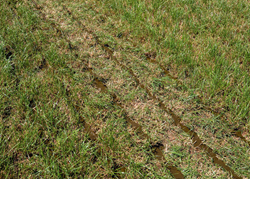 With recent FETF grants making slurry separators more affordable, there is increased interest in how to make improvements to grassland using separated slurry. This, coupled with another sharp rise in fertiliser prices, presents an opportunity for many dairy farms to make significant savings.
A 2026 study has set out the numerous benefits that separation offers farms with grassland systems. The study identifies that the use of separated slurry significantly increased plant productivity by 12%, plant Nitrogen (N) uptake by 21%, and total biomass harvest N export by 20% compared to an unseparated slurry alternative.
For farms looking to reduce reliance on bought-in fertiliser, the study also showed that fertiliser N retention in topsoil organic N (SON) increased by 8%. The knock-on effects led to higher plant uptake and higher soil storage of fertiliser N, with total gaseous N losses from separated slurry reducing by almost 25 percent.
Slurry specialist Andy Hayhurst from Vogelsang, and Eurofins Agro's Shane Brewer, advocate that its findings can help farms to utilise slurry more efficiently to boost grassland productivity.
"Separation makes slurry more manageable and enables it to be applied more accurately. The study suggests that applying a separated liquid in spring when soil microbial activity is lower will help reduce the loss of precious N and other important nutrients. Subsequently using the solid fraction is more efficient in summer and that this combination can help reduce harmful greenhouse gas emissions such as ammonia being released when slurry is applied," says Mr Hayhurst.
The shift towards using dribble bar and trailing shoe applicators has also given rise to slurry separators, which provide a liquid fraction that can be pumped faster and more efficiently using narrower hoses. Using precision applicators also enables operators to get the N rich liquid directly on to the soil, which Mr Brewer suggests is a key agronomic benefit.
"Soil health is more easily controlled when an accurate calculation of available nutrients is made. Therefore, farms that test soil to establish the nutrient need, and subsequently test separated slurry to establish its content, will be able to use flow meters to apply the optimum volume of slurry to each field based on what the soil and the crop need," he says.
During the spring and summer months when soils can be dry and potentially drought stricken, as was seen in 2025, having a more liquid slurry to apply has additional advantages, especially for grassland.
"Last year, some farms will have seen slurry drying rapidly on the surface, with many of the vital nutrients locked up in the dry matter that was left either on grass or on top of the soil. The ability to utilise granular fertilisers dissipates during hot weather, especially when there is no rainfall, so having a ready supply of easily absorbed liquid slurry can help provide vital nutrients at this time," says Mr Hayhurst.
For farms looking to multi-cut systems to feed housed cattle and produce more milk from forage, the use of slurry is paramount to stimulating growth throughout the growing season. Rather than simply applying slurry before first cut and aiming to have an empty tank in autumn to help with overwintering a herd, multi-cut systems have demonstrated that careful and accurate use of slurry can provide more forage.
"Whether growing grass or maize, farms will benefit from separating slurry if there is a need for timely and ongoing applications during the growing season. Beneficial bacteria in soil are stimulated by easily degradable materials with a low C/N ratio such as slurry. Calibrating application based on accurate testing of a liquid fraction is a more accurate method and will enable farms to better control the balance of soil and plant available nutrients in a sustainable way," says Mr Brewer.
The study further identifies the benefits of separating slurry by comparing the composition of slurry and its capacity to make N available to the soil and, subsequently, the crop. The findings suggest that the organic nature of slurry makes it more variable.
Although the readily available N content liquid slurry is lower than that of synthetic fertilisers, the presence of urine-derived urea significantly increases the proportion of ammoniacal available N, which often exceeds 50% of total N. In contrast, the solid fraction or dry matter only contains about 9% of readily available N.
"Without separation, the application of N from slurry is far less accurate and less efficient. This study identifies that, with separation, slurry is 41% greater in total N than the solid or dry matter that is extracted. This clearly shows that removing the dry matter helps to more accurately establish the N value as well as provide a liquid that can be applied more accurately and directly to the soil where it can be absorbed," says Mr Hayhurst.
With sustainability goals, increasing fertiliser costs, reducing milk prices and grants available for separators, the information from this study is timely. It reinforces what many have been thinking and should help clarify the full benefits of slurry management to grassland productivity.
Vogelsang
|
|
|
|
|
Poland - Poland wants to increase the export to Algeria. Market access for dairy products as the subject of the talks
Restrictions on access to the Algerian market - particularly for dairy products - make the development of Polish export difficult. The Secretary of State Jacek Czerniak recently held talks with the Ambassador of Algeria Mohamed Salah Belaid about the possibilities of lifting those restrictions and increasing the presence of Polish food in Algeria.
"We want to expand the presence of Polish products on foreign markets and eliminate barriers that impede the export. The Algerian market has a great potential for our agri-food industry," emphasised Deputy Minister Jacek Czerniak.
The meeting was organised on the initiative of the Polish party, in response to signals from the dairy industry. The Polish Chamber of Milk requested the Ministry of Agriculture for support in solving problems related to access to the Algerian market. The talks concerned specific restrictions hindering the export of dairy products from Poland and the possibility of their lifting in dialogue with the Algerian party.
Trade between Poland and Algeria in the agri-food sector remains at a high level, however, its structure indicates the untapped potential in some sectors.
In 2025, the value of agri-food export from Poland to Algeria amounted to around EUR 279 million. At the same time, the import from Algeria remain marginal - in 2025, its value amounted to around EUR 0.6 million. Thus, Poland maintains a clear trade surplus, which exceeded EUR 278 million.
The export structure is highly concentrated. In 2024, sales of milk and concentrated cream amounted to around EUR 193.5 million and in 2025 decreased to around EUR 134.9 million. Other dairy products - such as whey or fermented products - have a much smaller share in this market.
Restrictions on market access, including in the dairy sector, do not allow to fully tap the export potential. Their lifting could translate into a greater diversification of sales and the increased presence of Polish companies in Algeria.
www.gov.pl/web/agriculture/poland-wants-to-increase-the-export-to-algeria-market-access-for-dairy-products-as-the-subject-of-the-talks
|
|
|
UK - The Beaufort Herd named British Friesian Herd of the Year for 2026
Holstein UK are pleased to announce this year's recipient of the British Friesian Herd of the Year. The award for 2026 goes to the Beaufort herd, owned by James and Louise Macpherson, who farm near Burton-on-Trent, Staffordshire, milking a total of 290 British Friesians.
This award is aimed at recognising the top-performing British Friesian herd each year, based on a combination of classification and production.
The Macphersons originally started farming in Dorset, and their love of the British Friesian started when they bought the core of the Rodbrook herd from Chris Pemberton in Cheshire in 2012, moving these down to their county council farm. Further British Friesian bloodlines were added to the herd from the Langley and Goonhilly prefixes. Through developing bloodlines and management, acknowledgement of the herd's superior production was awarded and recognised within the breed.
Over the years, the herd has bred numerous bulls that have been sold into stud at Genus, notably Beaufort Milkman and Beaufort Karactacus, and more recently Beaufort Supersonic and Beaufort Jackery.
The milking portion of the herd was dispersed in 2018 at Sedgemoor Market, with the herd moving to a new unit in Staffordshire and milking resumed in 2019 with heifers coming through from the original cow families. Additional bloodlines were purchased from Collycroft and Catlane herds.
Numbers have steadily grown to the current number of 290 head, and the herd is now a closed herd, with surplus heifers being sold throughout the year when availability allows. In 2018, the Macphersons were awarded the NMR Chairman's Cup at Dairy-Tech.
Holstein-uk.org
|
|
|
UK - Company 'ALL THINGS' invests in Yester Farm Dairies to scale cheese production as demand surges
 ALL THINGS has completed an equity investment into Scottish producer Yester Farm Dairies, one of its key supply chain partners, to support the next phase of growth in cottage cheese production.
The investment will fund upgrades in machinery, increase production capacity and create a stronger platform for future innovation as ALL THINGS continue to scale across the dairy aisle.
Toby Hopkinson, Co-Founder of ALL THINGS, said: "From day one, our ambition has been to build a modern British dairy brand rooted in quality, provenance and long-term thinking. Yester Farm Dairies shares that vision. This investment is about more than scaling production, it is about investing in the infrastructure, partnerships and supporting a family owned business that will help shape the future of the category."
Supporting British farming is core to the ALL THINGS brand ethos, the company's supply chain and production are based entirely in the UK. Run by husband-and-wife team Simon and Jackie McCreery, Yester Farm Dairies is known for producing high-quality, fresh dairy products. The business began producing cottage cheese for ALL THINGS in December 2025, and within just 12 weeks, ALL THINGS Cottage Cheese is outperforming long-standing incumbents and delivering category-leading velocity across retailers. The company also donates 1% of revenue to RABI* while Yester Farm Dairies supports RSABI**, which provides practical, emotional and financial support to those working across Scottish agriculture.
RetailTimes
|
|
|
UK - Marshfield Farm launches Acres: a new ice cream range developed specifically for chefs
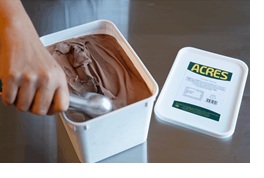 Marshfield Farm Ice Cream has announced the launch of Acres - a new ice cream range created specifically for chefs and developed for performance in professional kitchens.
Produced on the family's 1,200-acre regenerative dairy farm in Wiltshire, Acres has been created to meet the practical demands of busy kitchens, combining quality ingredients with the stability and consistency required during busy service.
The range reflects a new stage of innovation for the business, pioneered by the next generation of the Marshfield Farm family, and backed by more than three decades and three generations of ice cream-making expertise.
While many ice creams used in hospitality are created primarily to stand alone as a dessert, Acres has been formulated to behave more like an ingredient on the plate, complementing other elements of a dessert rather than overpowering them, say the company.
Low overrun reduces air within the ice cream, creating a denser texture and richer mouthfeel, while cream levels have been carefully calibrated to ensure the ice cream remains indulgent, yet balanced when paired with plated desserts. The range encompasses four flavours - Madagascan Vanilla, Chocolate Sea Salt, Caramel Sea Salt and Strawberry - each supplied in 4.5 litre tubs with an RRP of £24.38.
As a producer that controls its supply chain from field to freezer, every batch of Acres begins with fresh milk from the farm's own herd of 250 cows, with around 95% of the cows' feed grown on the farm itself. This level of control over production allows the business to maintain tight consistency in milk quality and flavour, while supporting its wider regenerative farming approach. Flavours have been developed using carefully selected ingredients including Madagascan vanilla, 52% cocoa mass dark chocolate, hand-harvested Cornish sea salt, and fresh strawberries.
Each ingredient has been chosen to deliver clear, concentrated flavours that perform reliably in a professional kitchen environment.
WholesaleManager
|
|
|
USA - Organic dairy farmers sue US government over milk pricing system
Organic dairy farmers in the United States have launched a series of legal challenges against the federal government, arguing that current milk pricing rules unfairly disadvantage their sector and divert revenue to conventional producers.
Three federal court filings submitted by members of the Coalition for Organic Dairy Exemption (CODE) contest the constitutionality of requiring organic producers to participate in the US Department of Agriculture's Federal Milk Marketing Order (FMMO) programme.
In parallel, a class action claim seeks compensation for what farmers describe as six years of improperly collected payments into the system.The plaintiffs argue that the FMMO structure forces organic producers to contribute to a pricing pool that does not return value to them. Elvin Ranck, an organic dairy farmer in Pennsylvania and one of the claimants, said the system "actively harms organic dairy farmers" by redistributing income generated from organic milk sales to non-organic producers.
Ranck added that his cooperative, CROPP Cooperative, pays millions of dollars annually into the FMMO pool without receiving any financial benefit in return, describing the arrangement as equivalent to a government taking. Organic dairy now represents more than 10% of US dairy farms, with its share of fluid milk sales rising from 1.9% in 2006 to 7% in 2025. Industry representatives argue that the current pricing framework undermines this growth by extracting resources that could otherwise be used to expand production and meet rising consumer demand.
CODE members claim that successive administrations have failed to address the issue despite repeated efforts by the organic sector. Proposals submitted in 2015 were not advanced, while organic-specific recommendations raised during a national FMMO hearing in 2023 were not considered. Further objections and administrative challenges lodged in 2024 and 2025 have also gone unresolved.
www.foodbev.com/news/organic-dairy-farmers-sue-us-government-over-milk-pricing-system
|
|
|
|
| |
BRITISH DAIRYING
ENSURE YOU RECEIVE EVERY COPY
British Dairying is available by subscription at £70.00 posted to UK addresses,
£90.00 for Europe, £115.00 for the Rest of the world
or £30 +VAT for British Dairying Online only
|
|
|
QUOTE
Reasons to be cheerful . . . there are always some to be found . . .
"A merry heart does good like a medicine"
(Proverbs 17:22)
"A good laugh is sunshine in the house."
William Makepeace Thackeray
"He who laughs most, learns best."
John Cleese
"There is nothing in this world so irresistibly contagious as laughter and good humour."
Charles Dickens
|
|
| |
|
|
|
You are receiving this email because you are a registered reader of British Dairying and we are pleased to send you extra information to supplement the journal.
|
|
|
British Dairying,
Grove House Media Ltd
Priory Cottage, Eastbourne Road Ridgewood East Sussex TN22 5ST
Grove House Media Ltd is registered in England and Wales, Registration No 16722598
|
|