|
|  |
|
June 16, 2026
|
|
UK - AHDB launches new SFI cost/benefit tool for farmers
A new online Sustainable Farming Incentive (SFI) cost/benefit tool to provide bespoke support for farmers has been launched ahead of the SFI26 scheme going live.
AHDB have created the tool to help farmers better understand how SFI actions could impact their individual businesses and support more informed decision-making.
It is the latest in a series of resources we have developed to help farmers navigate the evolving SFI landscape, building on previous work that has supported industry understanding of scheme opportunities.
Developed with farmers, it goes beyond headline payment rates by factoring in the costs of implementing specific SFI actions. This enables users to estimate not only the income they might receive but also the likely net financial benefit once costs are considered.
Building on our previous analysis, which used representative 'model farms' to illustrate potential impacts, the new tool allows farmers to input information relevant to their own businesses, providing a more accurate, tailored and practical assessment of options.
It has been specifically designed to provide continued support for farmers and farm business decision-makers affected by the transition away from the Basic Payment Scheme (BPS) while supporting those exploring opportunities under SFI 2026 across the cereals and oilseeds, beef and lamb, dairy and pork sectors.
By translating SFI actions into important business metrics such as income, costs and net financial benefit, the tool helps users:
- Identify which SFI actions are financially worthwhile
- Understand where on the farm those actions make the most sense
- Assess the opportunity cost of taking land out of production
- Explore how different actions work together when combined (stacking)
For more information, visit AHDB
|
|
|
|
|
UK - GB producer numbers: declining due to a difficult year
In the latest AHDB survey of major milk buyers, it is estimated that there were 6,850 dairy producers in GB as of April 2026. This is a substantial reduction of 160 producers (-2.3%) which was estimated since our last survey in October 2025.
Looking at year-on-year changes since April 2025, there was an estimated decline of 190 producers (-2.7%) indicating that the majority of the industry exits took place last winter.
Favourable dairy economics during the summer months would have stemmed the flow of producers leaving the industry. However, this accelerated during the winter months as margins were squeezed following the decline in milk prices, forage shortages for some and increasing input costs.
According to the latest BCMS figures, the GB milking herd totalled 1.59 million head as of April 2026, another lowest number recorded, and a 2.0% decline compared to the same month the previous year. The GB total herd stood at 2.46 million head, a year-on-year decline of 2.0%.
Average milk volume per farm in GB has now increased to an estimated 1.90 million litres (+7.6%) for the year from April 2025 to April 2026, denoting the continued trend towards consolidation and fewer but larger farms.
Milk deliveries have declined in the recent weeks putting a brake to the record-breaking milk volumes in the last milk season (2026/27). There is an estimated decline of 0.9% in May year-on-year. However, one should keep in mind, we are annualising against a year of record highs and there is still lot of milk in the market. We will be releasing our updated quarterly milk production forecast later this month.
Favourable cull cow prices (above 5-year average despite recent pressure) and continued inflationary pressure on key input costs incentivised some producers to exit the industry as farm margins tighten.
Farmer sentiment is largely negative with squeezes on both milk prices and costs of production, with now a falling beef price putting dairy farm businesses under increasing pressure.
Milk prices have stabilised in the last two months but will need to improve further to increase farmer confidence in the sector. Hopes for this are dependent on markets which remain uncertain.
Figure 1. GB dairy producer numbers and volume per farm (April 2021-April 2026) Source: AHDB
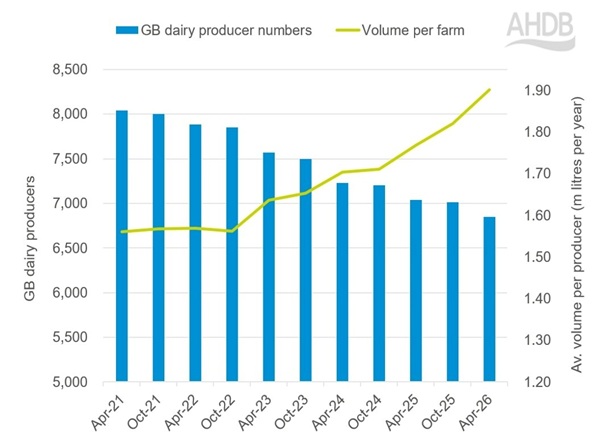
Figure 1 shows the number of dairy producers steadily declines over time, falling from just over 8,000 in 2001 to under 7,000 in 2026. In contrast, the average milk volume per farm gradually increases, rising from around 1.6 million litres per year to nearly 1.9 million litres. Overall, fewer farms are producing more milk per farm.
Historic data can be found on the AHDB producer numbers page.
|
|
| |

|
To find out more about Neogen Igenity can help build stronger foundations for your business, click here.
| |
|
|
|
UK - Optimize your heifer inventory
A combination of genomic testing and applying strict targets for the use of sexed semen to control the number of heifers reared and entering the herd can increase the return on investment in heifer rearing and the rate of genetic improvement.
"Strong foundations are central to building a more resilient business that can withstand a wide range of unpredictable global and domestic price and supply shocks," comments Rob Horn from Neogen. "Farmers will need data-driven tools to help them make confident and profitable decisions. Possibly the most fundamental foundation is the cows in the herd, ensuring you have the best, most efficient herd possible and genomic testing will ensure the herd continues to improve."
Genomics are becoming more widely accepted as the gold standard for planning future herds and maximising the return from breeding strategies, with over 112,000 heifers tested in 2024, a 19% increase year on year. And you only need to test your animals once as their genetic make-up is with them for life.
Mr Horn advises farmers to use genomics as a way to optimise genetic progress but also to use it to focus heifer rearing. He suggests that with the widespread adoption of sexed semen it should be possible to better control the number of heifers produced
Mr Horn says using only sufficient straws of sexed semen to produce a target number of heifers required to enter the herd is an alternative genomics strategy which will optimise genetic improvement, improve herd economic efficiency and reduce costs. This, accompanied with a move to reduce replacement rates to increase average number of lactations can produce a more robust herd, better exploiting genetic potential.
"Following this approach will have a range of benefits. Rearing fewer heifers will reduce total rearing costs. It will also increase the number of animals that can be bred to beef, increasing the total income from beef calf sales. It can also reduce the total spend on semen. Finally, you will be bringing better animals into the herd."
To find out more about Neogen Igenity can help build stronger foundations for your business, click here.
|
|
|
UK - QMS-supported pilot shows surprising results
 Initial findings from a pioneering environmental baselining pilot, suggests that current carbon accounting methodologies could significantly underestimate the amount of carbon stored in Scottish soils, with on average 30% or more of soil organic carbon on the pilot farms sitting below the commonly measured 30cm depth.
The pilot, delivered by AHDB with support from Quality Meat Scotland (QMS) and Hybu Cig Cymru - Meat Promotion Wales (HCC) is working with 178 farms across British agriculture, including 35 in Scotland of which 22 are beef, lamb and pork. It represents one of the most detailed assessments of carbon stocks across British farmland in recent decades.
Using soil sampling to depths of up to one metre where possible, alongside LiDAR scanning of above ground features, the project has generated a robust baseline of environmental data. Over 53,000 soil cores have been collected across more than 5,000 fields, with analysis now underway.
Early findings from the initial 170 farms show that around 95% of estimated carbon stocks on participating farms are held in soils, with the remainder stored in trees and hedges. In addition, analysis to date suggests that the level of carbon storage on participating Scottish farms may be higher than the other participating farms (139 carbon tonnes per hectare in Scotland compared to 128 carbon tonnes per hectare in Great Britian).
There is also huge variation between soils, with some fields in Scotland exceeding 600 carbon tonnes per hectare.
QMS Chief Executive, Sarah Millar, said: "As the rest of the results continue to come through, we look forward to further understanding the strengths and opportunities of Scotland's natural climate, landscape and farming systems to support Scottish farmers in sustainable food production for generations to come."
Alongside carbon stock measurements, each participating farm has also completed a carbon audit. These audits estimate greenhouse gas emissions and removals through a carbon calculator and help farmers identify tailored actions for their own businesses.
QMS
|
|
|
UK - Key takeaways from the 2026 Eucolait General Assembly - reflections from a GB perspective
Close to 300 attendees, including some of the biggest European and global movers and shakers, attended Eucolait (which is the largest European dairy trade association) in their Annual General Assembly, a three-day conference including two days of market insights held in Italy in early June 2026.
Industry attendees were eager to find some market direction after what has been one of the most challenging periods for dairy markets in recent history, blighted by over-supply and falling commodity prices.
So, did we come away with a clear sense of travel? And how might this impact GB dairy farmers? As always, the answer - it depends - on what markets and what commodities you might be servicing.
AHDB's, Lead Analyst Dairy, Susie Stannard, highlights the key takeaways
UK - AHDB-led pilot shows current soil carbon measurement methodologies may be underestimating carbon stocks by a third or more
Initial findings from our pioneering environmental baselining pilot suggest that current carbon accounting methodologies could significantly underestimate the amount of carbon stored in soils, with 30% or more of soil organic carbon on the pilot farms sitting below the commonly measured 30cm depth.
The Environment Baselining Pilot, delivered by AHDB with support from Quality Meat Scotland (QMS) and Hybu Cig Cymru - Meat Promotion Wales (HCC), is working with 178 farms across the beef and lamb, cereals and oilseeds, dairy and pork sectors in England, Scotland and Wales.
It represents one of the most detailed assessments of carbon stocks across British farmland in recent decades.
Using soil sampling to depths of up to one metre where possible, alongside LiDAR scanning of above ground features, the project has generated a robust baseline of environmental data.
Over 53,000 soil cores have been collected across more than 5,000 fields, with analysis now underway.
Early findings from the initial 170 farms show that around 95% of estimated carbon stocks on participating farms are held in soils, with the remainder stored in trees and hedges and analysis to date suggests that 30% or more of soil organic carbon stock sits below the 30 cm depth.*
There is also a huge variation between soils. Across the farmland analysed so far, the average soil carbon stock is around 128 tonnes per hectare, but some fields exceed 600 tonnes per hectare.
Farmland in the Cambridgeshire Fens and Somerset Levels have returned the highest values, with deep, organic peat soils showing particularly high carbon stocks.
Learn more about the Environment Baselining Pilot
|
|
|
UK - Pioneering water quality initiative across 700 dairy farms
First Milk is rolling out a new freshwater strategy across its 700 member farms, addressing a long-standing challenge for the dairy sector: how to measure and target water quality risks practically and consistently at farm and field level. The work comes amid growing national focus on river health, freshwater resilience and the need for more targeted, evidence-led approaches to land and water management.
Drawing on two years of nutrient footprinting, developed with Farm Carbon Toolkit, and satellite-led risk mapping produced by Senus, the approach identifies where nutrient pressure and landscape risk overlap. This allows support and intervention to be prioritised where it can have the greatest impact on rivers and waterways while supporting productive, resilient dairy farming.
At the heart of the strategy is nutrient footprinting, which tracks the flow of nitrogen and phosphate through a farming system. This helps identify where nutrients are being used efficiently and where imbalances may create unnecessary environmental pressure, providing farmers with practical insights to improve both resource use and environmental performance.
Together, these tools provide a practical, scalable way to identify, prioritise and manage water quality risks across one of the UK dairy sector's largest on-farm freshwater datasets, supporting more targeted catchment-level action. Early analysis shows that lower nutrient-footprint farms can achieve similar milk production levels to higher-footprint farms, suggesting productive dairy farming and stronger water stewardship can go hand in hand.
The nutrient footprinting work has identified different drivers behind potential nutrient imbalance. The analysis shows that nitrogen pressure is most closely linked to land use, fertiliser and stocking density, while phosphate pressure is more closely linked to feed use and efficiency.
Meanwhile, the Senus water risk maps assess every field according to factors including slope and proximity to watercourses, helping farmers identify where there may be a higher risk of nutrients moving into rivers and streams. The strategy builds on measures already embedded within First Milk's regenerative farming programme, including rotational grazing, maintaining living roots, improving soil structure and fencing watercourses. First Milk says the new approach will also support more targeted collaboration at catchment level with local partners and community groups focused on improving water quality.
FirstMilk
|
|
|
UK - Defra increases ADOPT funding limit to support larger farmer-led innovation projects
Farmers, growers and foresters can now apply for larger farmer-led innovation projects through the latest round of Defra's ADOPT (Accelerating Development of Practices and Technologies) fund, with the maximum eligible project costs increasing from £100,000 to £200,000.
The change has been introduced due to feedback from the farming community, enabling more ambitious on-farm trials that can involve a greater number of farmers and partners, generate more robust evidence and deliver wider benefits across the sector.
The increased funding limit applies from Round 8 onwards, which is now open for applications, and comes as Defra also confirms the continuation of the programme beyond its previously published schedule. Funding opportunities are offered through a rolling programme, with a new application window opening approximately every eight to nine weeks as soon as the previous round closes.
Defra has announced two further funding rounds beyond those previously scheduled. While dates for Rounds 11 and 12 are yet to be confirmed, the announcement provides additional certainty for farmers, growers and foresters considering future innovation projects and reinforces the Government's ongoing commitment to farmer-led innovation.
Delivered by Innovate UK, ADOPT supports practical, farmer-led projects that test new approaches, ideas and technologies to address on-farm challenges and improve farm productivity, sustainability and resilience. The increased funding threshold will make it easier for ideas to be tested across multiple farms and growing conditions, while also creating greater opportunities to involve researchers, technology providers and industry partners where additional expertise can strengthen the work.
While the maximum project size has increased, the core principles of the programme remain unchanged. Projects must continue to be farmer-led, collaborative and focused on practical, on-farm testing. The minimum eligible project cost remains £50,000 and projects of all sizes will continue to be assessed against the same criteria.
Farmers, growers and foresters whose ideas may previously have been constrained by the £100,000 limit can now revisit those proposals, while applicants who were unsuccessful in earlier rounds are welcome to refine their projects using the feedback received and submit a new application.
Alongside funding, applicants have access to free support and guidance through the ADOPT Support Hub, delivered by ADAS, UK Agri-Tech Centre and the Soil Association. The service provides one-to-one support throughout the application process and project delivery.
More information about funding and support can be found at https://farmpep.net/adopt.
Explore ADOPT-funded trials at https://farmpep.net/adopt/live-projects.
|
|
|
Tried and Tested: Helping Farmers Choose the Right Cow Brush
Investing in new equipment is never without risk. You can research, compare and even see products in action, but until they are on farm, it is hard to know how they will really perform. That is exactly why Kingshay's Tried & Tested reports exist: to give farmers access to honest, independent feedback from others using the same products day in, day out.
Our next report focuses on cow brushes; an increasingly popular investment to improve cow welfare. But with wide variation in build quality, reliability and price, choosing the right option isn't always straightforward.
This is where your experience matters. Every survey response helps build a clearer, more reliable picture of what works well on farm, and just as importantly, what doesn't. The more farmers who take part, the stronger and more useful the results become for the whole industry.
The survey takes just a short time to complete, and participants will be entered into a £100 Amazon voucher prize draw. Most importantly, you will be helping other farmers make better-informed decisions and avoid costly mistakes.
If you use cow brushes, take part today; your insight could make all the difference.

|
|
|
UK - Apply now for the West Country dairy fund in 2026
Students with ambitions to build a career in the dairy industry are being encouraged to apply for financial support through the West Country Dairy Awards.
Established in 1925, the awards provide grants to people studying courses linked to the dairy sector, with more than £20,000 distributed to successful applicants each year.
The scheme is open to students of all ages undertaking further education related to the dairy industry. Sons and daughters of farmers and farm employees are eligible, plus those who can demonstrate a commitment to the sector and show potential to add value to the industry in the future. Applicants must live in Cornwall, Devon, Dorset or Somerset.
All candidates are interviewed within their home county, with the strongest applicants progressing to a final interview day, usually held in September. While all qualifying applicants receive financial support, finalists are awarded larger grants.
The awards cannot provide funding for students undertaking work placements or work experience. Applications close on July 31, 2026.
www.southwestfarmer.co.uk/news/26163836.apply-now-west-country-dairy-fund-2026/
|
|
|
|
| |
BRITISH DAIRYING
ENSURE YOU RECEIVE EVERY COPY
British Dairying is available by subscription at £70.00 posted to UK addresses,
£90.00 for Europe, £115.00 for the Rest of the world
or £30 +VAT for British Dairying Online only
|
|
|
QUOTE
"You can live your life. You can accomplish. You can accumulate a lot of stuff. You can fill your house and then fill your garage and fill your basement. But you cannot live a rich life if you don't have empathy."
Henry Winkler, Actor and Producer, 1945 -
|
|
| |
|
|
|
You are receiving this email because you are a registered reader of British Dairying and we are pleased to send you extra information to supplement the journal.
|
|
|
British Dairying,
Grove House Media Ltd
Priory Cottage, Eastbourne Road Ridgewood East Sussex TN22 5ST
Grove House Media Ltd is registered in England and Wales, Registration No 16722598
|
|