|
|  |
|
August 4, 2026
|
|
UK - How could proposed extensification measures in the Netherlands affect the UK market?
Key points
- The Netherlands are an important dairy producer within the EU and in 2025 they accounted for 9% of EU milk production
- The Dutch cabinet has replaced previous nitrogen plans with more sectoral specific ammonia emission targets for livestock farmers
- The cabinet plans to impose an upper limit of 2.6 livestock units per hectare from 2035, this will force more intensive farmers, around 30% of current farms to reduce livestock numbers or expand land area which also has additional requirements
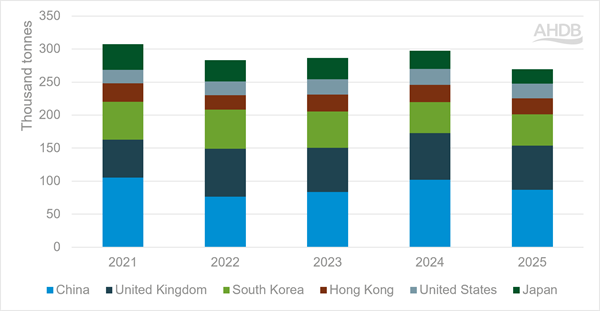
The Netherlands are an important dairy producer within the EU; in 2025 they accounted for 9% of EU milk production. A large proportion of dairy exports remain within the EU but outside of this the key destinations include China, the UK and South Korea (Figure 1).
We've explored how new plans to extensify livestock and dairy production could impact British opportunities.
Figure 1: Dairy exports from 2021 to 2025
Source: Trade Data Monitor LLC
Figure 1 shows that China remained the largest market throughout the period (2021-2025) and drove most of the year-to-year changes, while exports to the UK were broadly steady and volumes to South Korea, Japan, Hong Kong and the USA generally declined over time.
Read more of this analysis from AHDB's Hannah McLoughlin
|
|
|
|
|
UK - AMPE and MCVE updated to reflect latest costs in Q1 2026
Processing costs for dairy products were subject to inflationary pressures in the first quarter of 2026, thereby reducing the value of our market indicators AMPE and MCVE. These changes will be implemented in our latest publication
In Q1 2026, electricity increased by 3.1% and gas increased by 2.0% compared to the previous quarter. Inflation (as measured by the Consumer Price Index) increased marginally by 0.4% on the previous quarter.
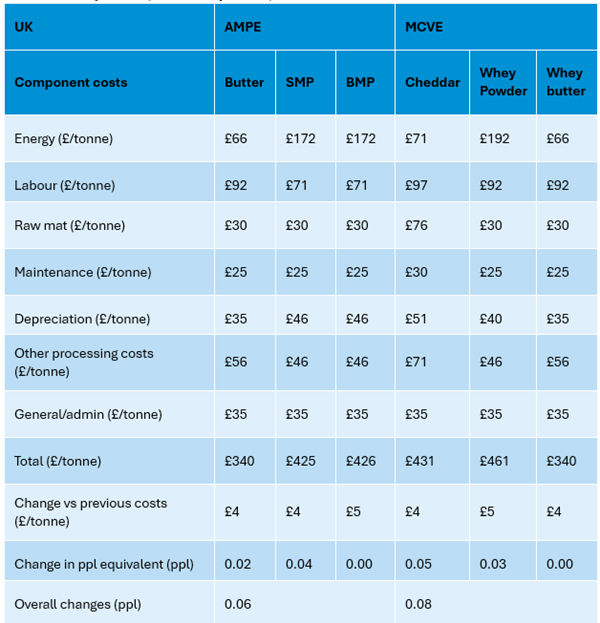
The net impact of the latest quarterly cost increases is for the average processing costs within both AMPE and MCVE to move up on the quarter. Overall, AMPE costs are now 0.06ppl higher and MCVE costs are 0.08ppl higher than the previous quarter.
The increase in gas and electricity prices and overall inflation were the main factors, which impacted the overall cost. Energy prices continue to remain at relatively high levels.
Note that this latest update only reflects inflation to March 2026, including data revisions. This will not fully account for inflation driven by the outbreak of conflict in Iran.
Labour costs have been carried over from Q4 2025 due to a delayed data publication from ONS.
The next update will be in October 2026 following the ONS release of the 2026 Q2 cost indexes.
A breakdown of the latest costs is given in Table 1.
Table 1. 2026 Q1 costs (£/tonne of product)
Source: AHDB
The new costs include changes in:
- Energy costs based on the movement in the average prices of gas and electricity purchased by the manufacturing industry in GB as quoted by BEIS, up to Q1 2026.
- Labour costs carried over from Q4 2025, based on the movement in the unit labour cost for the whole economy as quoted by ONS - due to a delayed data release Q1 2026 data was not available at the time of this publication.
- Other costs based on the movement in inflation (CPI) from the 2020 update to Q1 2026.
For further changes and to see how costs impact your own business, we offer an online spreadsheet that allows you to enter bespoke costs and milk quality into the calculations. This will then calculate unique indicators based on your own circumstances.
Read more dairy news from the AHDB website
|
|
|
|
|
UK - Dairy profits mask huge volatility
The financial year ended 31 March 2026 was a stronger one for some UK dairy farmers, but the situation now is very different, with a significant drop in milk price alongside drought conditions. Alongside this, January 2027 may bring a large tax bill, according to the annual Milk Cost of Production report by Old Mill accountants and the Farm Consultancy Group.
Headline figures show that the cost of production averaged 42.38p/litre against a total income of 54.81p/litre, boosting profits to 12.43p/litre - more than double the five-year average. However, this masks considerable variability between farms and systems and doesn't reflect the current reality of sharply lower milk prices and extreme weather challenges.
"Spring calving systems may have been best suited to the market conditions of 2025/26 given the higher milk price in the first half of 2025," explains Bradley Causey, rural accountant at Old Mill, part of the national Kinbrook Group. "Interestingly, we may see a reversal of this in 2026/27, with spring calvers possibly being least suited to the financial environment given the lower milk price this spring."
The report shows milk income rose to 46.38p/litre, while non-milk income (from calf and cow sales) rose to 8.43p/litre. However, all input costs increased against the five-year average, driven particularly by purchased feed. This is likely because the milk-to-feed-price ratio was extremely strong, encouraging farmers to feed for yield at a time of forage shortages. The figures also reveal that there is no correlation between milk yield and profit. "Extra litres can be expensive to produce, and it may be that controlling cost and hitting a profitable level of production is the better option," says Mr Causey.
Comparing the top and bottom 10% in terms of profit sees no clear definition between dairy systems; but technical performance and cost controls are key. "The top 10% are achieving the same milk production at a lower cost," says Allaster Dallas, a consultant at the Farm Consultancy Group. They are also commanding over 10p/litre more for their milk, bringing total income to 60.87p/litre against 50.19p/litre in the bottom 10%. Total costs came to 36.56p/litre versus 52.75p/litre, making for profits of 24.31p/litre against a loss of 2.56p/litre in the bottom 10%.
"Farm management, and not just external market conditions, is important," notes Mr Dallas. "It is not enough to focus solely on production, as cost structure can be key to success. Meeting the requirements of the processors and contracts will become more important in the future, as well as more communication about where your business will be in 12 months or even five years."
Looking ahead, 2026/27 is likely to see a massive drop in profits, to 3.96p/litre, driven by sharply lower milk prices and higher production costs. At the same time, producers could face a high Income Tax bill in January 2027, from the 2025/26 milk year. "Some in the industry may be concerned for the future," warns Mr Causey. This is not just due to volatile milk prices, but also increasing compliance requirements, political uncertainty and wider economic fragility.
However, producers who have invested in technology; particularly to reduce energy costs and improve genetics, are starting to yield rewards in both efficiency and cash, says Mr Dallas. Many producers are also selling dairy and beef animals to supplement their income and insulate against milk market volatility. "There is some light at the end of the tunnel, and the UK remains a competitive place to produce milk," he adds. "Hopefully, this report will inspire producers to review their costings and implement practical changes to maintain profitability. Ask yourself: What do we do well, and what can we do better?"
www.om.uk
|
|
|
UK - Dairy farmers encouraged to reduce losses through heat stress as high temperatures roll on
 Prolonged hot weather across the UK is taking its toll on dairy cows, with milk yield dips reported in many herds and the likelihood of reduced fertility. And we may not have seen the end of it, according to Cargill's ruminant specialist Donald Macleod. He's encouraging dairy farmers to make management and dietary changes that will help mitigate the effects of this heat stress and keep cows on track.
"Daily spikes in summer temperatures will affect cow productivity and behaviour - many dairy farmers across the UK have reported reduced milk yields since the hot weather has continued," he says.
"But prolonged periods of high temperatures will have longer lasting effects, and fertility is the key casualty. It's highly likely that heat detection and conception rates will have dipped and we won't see this immediately, but in a few months' time. By this point, it's too late to do anything except pick up the additional costs of additional fertility work and an extended calving interval."
Heat stress has become more of an issue in high-production cows which produce a lot of metabolic heat. "Cows producing 46kg of milk a day produce 26% more metabolic heat than those producing 32kg of milk a day," he explains. Management tweaks and using a cooling product in milking and dry cow diets will reduce the impact of heat stress on herd performance.
"Make sure there's a good supply of clean water and cow flow is optimised," adds Donald. "Fresh feed should be available at cooler times of the day to encourage intakes. Dips in production are most likely a direct consequence of depressed appetite from heat stress due to sub-acute ruminal acidosis." Using the specialised rumen buffer Equaliser CoolCow is also proven to mitigate the effects of heat stress in dairy cows. "I have many reports in the past five years from producers showing how this has kept production on track during high summer temperatures," he says.
Cargill's UK trials have also shown that the specialised buffer supports fertility. On eight farms where the temperature and humidity index (THI) was recorded and where actions were taken to reduce the effects of heat stress, including fans and Equaliser Coolcow, fertility performance was maintained in heat-stress conditions.
Results showed the best improvements were seen where fans and the rumen buffer were used with conception rates remaining more consistent and only dipping from around 40%, to 35% as the THI increased from 60 to 65 or above. This is above 22°C and 60% humidity, which is typical in a UK summer.
Added to concentrate or buffer feeds, the rumen buffer works by helping to restore a cow's electrolyte balance and regulating her core body temperature. "Because this specialised rumen buffer plays an important part in countering the negative effects of heat stress, which we've shown can affect most UK dairy herds during the summer, it's a cost that can be easily justified," says Donald
For close-up dry cows including the feed product CoolCalver, which also contains the specialist cooling pack found in CoolCow, valuable postbiotics and the energy-boosting, liver-priming feed supplement LiFT, the effects of heat stress can also be reduced. "Keeping cows active and maintaining feed intake will support more consistent fertility and milk production through the summer and into autumn and reduce the risk of setbacks caused by heat stress," he concludes.
Cargill
|
|
|
Brazil - Farmers tokenized dairy cows to get loans, bypassing bank lending limits
Farmers in Parana, Brazil, struggling to get banks to loan them cash, became the first to tokenize livestock and place 10 dairy milk cows' tokens for trade on the country's B3 national stock exchange. They generated nearly USD20,000 in credit backed by their cattle, signalling the potential of tokenizing RWAs as a financing tool.
The dairy cow tokenization in Brazil is a world first and serves as a test in a real-world scenario in which farmers are facing increasingly stringent lending limits imposed by local banks on small agricultural businesses. "We take the cow, which is a real and tangible asset, and transform it into a digital asset backed by a unique code monitored in real time," Thiago Martins of Cowmed, a Brazilian Agtec company, told CNNBrasil recently.
"This digitization allows for formal registration with B3 as a movable asset," Martins added. "The process is simple and gives the producer an advantageous opportunity to finance themselves, opening a new alternative for collateral at a time of strong credit restrictions in agribusiness."
To turn cattle into trusted financial guarantees or collateral without requiring inspectors to visit the property, Cowmed equips cows with an AI-powered Smart Collar. These collars constantly monitor health, behaviour, and location. The raw data is then converted into an encrypted digital identity tied directly to the B3 credit agreement.
Continuous tracking of cattle prevents farmers from double-pledging the same cattle across multiple loans. It also includes built-in safeguards that allow the farmer to swap one dead cow for a live one. Cowmed already tracks about 100,000 dairy cows across more than 1,000 farms. The herd is worth over USD395 million. The company expects up to 20% of its network to adopt this tokenized financing model, unlocking USD77.6 million in fresh credit for the agricultural sector.
www.coindesk.com/markets/2026/07/24/brazilian-farmers-tokenized-dairy-cows-to-get-loans-bypassing-bank-lending-limits
|
|
|
UK - Uncertainty damaging farm lets, warns CAAV
Increased uncertainty in the agricultural sector encouraged both landowners and farmers to take a shorter-term view of agreements in 2025. That's according to the latest annual Agricultural Land Occupation Survey carried out by the Central Association of Agricultural Valuers (CAAV).
Drawing on all 27 of the CAAV's local associations across England and Wales, the 49th survey covers land choices across 88,384 acres in the year to October 31, 2025. It found a net loss in let land of 4,510 acres, with the proportion of Agricultural Holdings Act (AHA) tenancies being re-let declining sharply. Historically, 75-80% of AHA tenancies have been re-let; this dropped to under 53% in 2025. At the same time, the proportion of units being sold when AHAs ended increased from a typical 8-10% to nearly 23%.
"Activity in the let sector remains overwhelmingly in terms of bare land," notes Jeremy Moody, secretary and adviser to the CAAV. "This has been the case for many years and is often a cause of misunderstanding. Only a small minority of lettings (6.8% in 2025) are of what would conventionally be called 'farms' with a house, buildings and land."
Reflecting a climate of increased uncertainty over economics, schemes and taxation, the average length of Farm Business Tenancies (FBTs) declined to its lowest level since 2021, dropping from 3.97 years last year to 3.38. Excluding those tenancies shorter than a year, the average fell from 5.05 to 4.65 years - the lowest since 2018.
"Over the years, these surveys have shown that periods of policy uncertainty see the average length of letting shorten," explains Mr Moody. "Wider issues; from farming economics to housing legislation, underpin this reality. In practice, the survey shows a similar pattern to previous years but with a shortening of the shorter terms granted, fitting the recognised pattern of reactions to concern and uncertainty.
"It is typically the shorter lettings that shorten at such times, with little or no effect on longer lettings which have greater consideration and often investment involved in them."
As is usual, larger holdings were more likely to be let on longer terms than smaller units, with new entrants also offered longer terms; 79% of new entrants obtained tenancies of more than two years compared to 62.5% of other tenants. "There may be seeds of change; 30% of new lettings where there was a change of tenant were to new entrants - the top end of the usual range. That could indicate the market opening up a bit."
Flexibility was the most common reason landlords gave for choosing the length of tenancy, cited by 37% of respondents, against 27% last year, while five per cent referred directly to uncertainty against two per cent last year. "Uncertainty increased in 2025, after the October 2024 Budget's Inheritance Tax proposals, alongside concern about schemes, economics and weather," says Mr Moody. "Very few decisions were made in 2025 because of the Inheritance Tax changes but they infused the wider mood of uncertainty.
"However, access to land is a key tool to raise productivity, and the tenanted sector has a potentially salient role in answering British farming's productivity challenge," he adds.
In Scotland, tenancy changes were made to 20,804 acres - down from 29,590 acres last year, with a net loss to the tenanted sector of 10,455 acres. The proportion re-let fell to 60% of holdings, down from 75% last year, while the average length of new tenancies declined from 4.31 year to 3.35 years - the lowest since this survey began in Scotland in 2011.
"Within the let sector, short bare land lettings remain the clearly predominant type of letting, and often just for interim management ahead of other uses - not using the full five years of a Short Limited Duration Tenancy," says Mr Moody. "Typically, only 10?15% of lettings include a house in the traditional sense of a farm letting, but in 2025 it was just 5%. This leaves the continuing scale of the seasonal grass lettings market as the major means for flexibility alongside informal arrangements and contract farming. With the political risks seen in letting in Scotland, owners withdrawing from farming are often more comfortable with non?tenancy arrangements."
The full survey is available at https://shorturl.at/aSYOV
|
|
|
|
| |
BRITISH DAIRYING
ENSURE YOU RECEIVE EVERY COPY
British Dairying is available by subscription at £70.00 posted to UK addresses,
£90.00 for Europe, £115.00 for the Rest of the world
or £30 +VAT for British Dairying Online only
|
|
|
QUOTE
Esto paratus
"The art of war teaches us to rely not on the likelihood of the enemy's not coming, but on our own readiness to receive him; not on the chance of his not attacking, but rather on the fact that we have made our position unassailable."
Sun Tzu - Chinese General and Philosopher 544BC-496BC
|
|
| |
|
|
|
You are receiving this email because you are a registered reader of British Dairying and we are pleased to send you extra information to supplement the journal.
|
|
|
British Dairying, Grove House Media LtdPriory Cottage, Eastbourne Road Ridgewood East Sussex TN22 5STGrove House Media Ltd is registered in England and Wales, Registration No 16722598 Us
|
|