|
|  |
|
June 23, 2026
|
|
Winners walks: Cream Award winners - Hook Farm Partnership
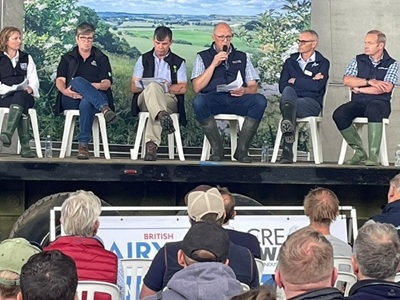
Hook Farm recently hosted 99 visitors at the first ever British Dairying and AHDB-organised on farm meeting. A long-established family farm operated by husband and wife team, Richard and Claire and Richard's father, James, the team was awarded the High Performance Dairy Farm title as well as the Fertility Health and Welfare Award in the 2025 Cream Awards last year.
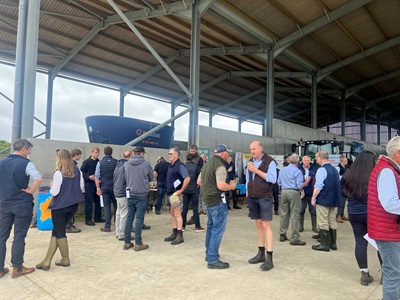
Standing out for cow performance from the 280 Holstein Friesian cows - 14,113 litres/cow from three times a day milking supplying Waitrose on a Muller contract - the judging panel was impressed with the whole team's attention to detail, use of data to drive decision making and openness to new innovations.
"The Cream Awards is an opportunity to not only celebrate the UK dairy industry and all its achievements, it gives recognition to farm teams and the consistent effort staff members put into delivering cow performance, health and wellbeing," chair of judges, and dairy farmer David Cotton told the meeting.
"Here at Hook Farm, the family is supported by a herd manager and full-time milker, a calf team of two, one other full-time member of staff who focuses on feeding and seven part-time workers," he added. "Every person in the team works tirelessly following the SOPs that have been developed with vet Kate Brodie from Drove Vets, and consultants Mike Bray from Kite and Ian Ohnstad from The Dairy Group. The fact that each of them has been working with Richard for 20+ years clearly shows the value of long-standing partnerships and collaboration."
The farm has fortnightly vet visits and emphasises preventative healthcare with vaccination for Q fever, leptospirosis, BVD and BTV. Colostrum management helps ensure a solid foundation for robust calves with colostrum tested and any below a reading of 22% on a Brix being supplemented. IgG testing of all the calves is also carried out to check antibody levels and that the passive transfer of immunity is inline with expectations. Calves are all Tag and Tested for BVD and, since 2019, the farm has been genomic testing as a tool to gather data for informed decision making.
Farm Facts: 14,113 litres/cow. Cell counts rarely exceed 92,000 cells/ml. Four quarter cases mastitis/100 cows/year.
Calving interval 385 days. AFC 23 months. Targeted antibiotic use - 7.86 mg/PCU
|
|
|
|
|
UK - Agricultural price index: How the conflict in the Middle East has affected input prices on farms in the UK
The Agricultural Price Index (API) reflects the price that farmers pay for farm inputs and the price they get paid for outputs, relative to the base year of 2020. With conflict in the Middle East escalating towards the end of February, AHDB look at how these global shocks have filtered through into changing costs on farms.
- API data for March shows total agricultural input price inflation rose by 3.7% year-on-year and was up 1.1% month-on-month, primarily driven by fertiliser, soil enhancers, fuels and lubricants.
- Inflation in output prices for commodities, including milk eased, meaning that input costs grew faster than the output. However, this is not directly linked to the conflict in the Middle East, with other key driving market factors across supply and demand.
- Suggestions to negate the impact of price rises include monitoring input prices such as fertiliser using the AHDB GB fertiliser prices and making the most of alternatives such as FYM or digestate. However, it remains difficult for farmers to negate the impacts of these input price rises, as divergence between input and output prices continue to increase.
Inputs: March 2026 data recorded that agricultural input inflation rose by 3.7% year-on-year and 1.1% month-on-month, continuing an upward trend. The key contributors to this increase were fertilisers and soil improvers. This aligns closely with the timing of the Iran conflict, which directly disrupted global energy and fertiliser markets.
The conflict affected the Strait of Hormuz, through which around one-fifth of oil and a large share of fertiliser trade passes. Disruption and perceived risk in this region led to sharp increases in oil and gas prices.
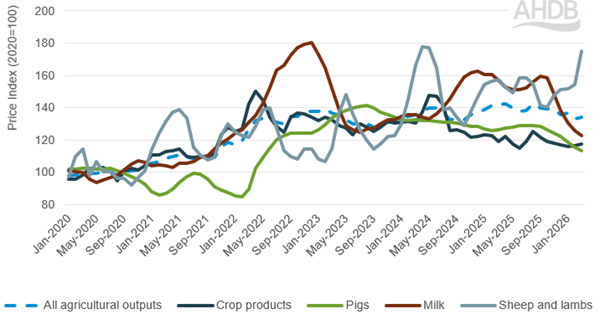
Outputs: In contrast to rising input costs, agricultural outputs were weaker overall, with the index value falling by 5.3% year-on-year in March 2026, although it did rise 1.1% month-on-month. This highlights a key issue for farm profitability: costs increased faster than farm-gate returns.
The decline in output prices was driven primarily by sectors such as milk and pigs. While some sectors like sheep and lamb provided positive contributions, these were not sufficient to offset broader downward pressure.
It is hard to quantify how much of the drop in output prices can be attributed to the conflict in the Middle East, as other attributing factors such as a global over supply of milk and oversupply of UK pork are key factors in these price drops.
Figure 2. UK Agricultural Price Index for Outputs
Source: Defra
The March 2026 API data underlines how quickly geopolitical tensions can feed through into UK farm economics, primarily via higher input costs.
The Middle East conflict has amplified existing pressures on fertiliser and energy markets, widening the gap between costs and farm-gate prices and tightening margins across most sectors.
While a range of mitigation strategies exist, their practicality is often constrained by cashflow and confidence, particularly in a low-margin environment.
As a result, the current situation reinforces the importance of careful cost control, flexible decision-making, and resilience planning, as farms continue to navigate volatile global markets.
Read the full article: Agricultural price index: How the conflict in the Middle East has affected input prices on farms in the UK | AHDB
|
|
|
UK - Bute Energy banks £160M for Welsh wind farm
Bute Energy has secured £160 million in project financing from Lloyds and Rabobank for the 94MW Twyn Hywel Energy Park in Caerphilly, south Wales. The company said construction will commence in early summer following financial close and is expected to complete by the end of 2027.
Twyn Hywel is the first project in a pipeline of 12 onshore wind developments in Wales with a total capacity of more than 2GW. The project received consent from Welsh Ministers in November 2024.
"Securing the project financing for Twyn Hywel Energy Park is a landmark moment, not just for this project, but for Bute Energy as a business," said Sid Anverali, project director at Bute Energy. This is our first project to move into construction, and that milestone reflects years of rigorous development work and the confidence our financing partners have placed in us."
"Backing this large-scale South Wales wind project reinforces Lloyds' leading role in infrastructure and project finance and our support for expanding the UK's onshore wind capacity," said Tony Hable, managing director & head of infrastructure and project finance at Lloyds.
https://renews.biz/112182/bute-energy-banks-160m-for-welsh-wind-farm/
|
|
|
UK - RABDF launches Dairy Entrepreneurs Club
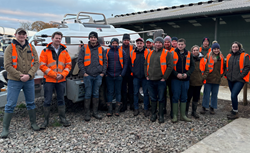 The Royal Association of British Dairy Farmers (RABDF) has launched a dedicated Entrepreneurs Club to bring together former participants of its long-running Entrepreneurs in Dairying (EiD) programme and support ongoing development across the dairy sector.
Building on the success of the EiD programme, the RABDF Entrepreneurs Club creates a network for former course delegates, offering ongoing opportunities for learning, collaboration and peer-to-peer support. RABDF Chief Executive Hayley Campbell-Gibbons said: "This new Club is an exclusive network open to all delegates of the Entrepreneurs in Dairying Programme over the last 14 years.
"Those who have been through the programme keep telling us they want more; that the learning and networking EiD offers shouldn't stop when the programme ends. With the launch of the Club, we're meeting that need. The Club will deliver something genuinely valuable and unique that supports aspiring dairy producers and those looking to further their careers in farming as they build, manage and grow their businesses. It will also open up opportunities for members to gain board-level experience within the industry, should they wish, helping to further develop governance, leadership and strategic skills," she added.
The initiative forms part of RABDF's wider strategy to support progression in the dairy industry, opening channels for sharing knowledge, learning through experience, promoting excellence and supporting the development of future industry leaders. RABDF Vice-Chair, Tim Downes said: "The Entrepreneurs in Dairying programme has supported almost 500 aspiring dairy producers since its launch in 2012, delivered in conjunction with The Andersons Centre, AHDB Dairy and the NFU."
One of those former delegates is Andrew Edwards, who completed the programme in 2025. He said: "The networking was unbelievable and the programme opened so many doors for me. Since completing EiD, I've secured a contract farming agreement and continue to benefit from the contacts and opportunities it created.
"The Entrepreneurs Club will be a fantastic way to keep learning, sharing ideas and supporting like-minded people across the industry."
|
|
|
|
|
UK - FREE TICKETS up for grabs for inaugural Volac Maize Symposia
A limited number of free tickets are up for grabs for Volac's inaugural Maize Symposia, taking place at the start of July. The events will see global experts from around the world take to the stage to share the latest research findings and practical tips for farmers under the theme: "Making the Most of Maize: King of the Forage Crops."
The symposia will be held on Tuesday 7th July at Exeter Sandy Park, Devon, and Thursday 9th July at Harper Adams University College, Shropshire. A limited number of free tickets are available via Eventbrite by entering the code EXETER100 or HARPER100 at checkout.
Jackie Bradley, Global Product Manager Forage for Volac, says the events have been designed to cover all stages of maize production, providing growers with practical advice, underpinned by the latest research findings and innovative thinking.
"It's the ideal event for maize growers looking to take their maize management to the next level. For example, Cody McCary from the States will be talking about how drones are being used in the USA to 3D model silage clamps, plan flan feed out, accurately measure forage stocks and review clamp management. He will also cover how this might be applicable in the UK," she explains.
Iwan Vaughan, ruminant nutritionist at Dairy Diagnosis in Wales, will also draw on findings from his 2017 Nuffield Farming Scholarship on low protein feeding. He will highlight how maize can be used to meet milk processor requirements to reduce total dietary crude protein levels, whilst maximising feed conversion efficiency.
View the full speaker line-up and book your FREE tickets now at Eventbrite:
Exeter Sandy Park and enter EXETER100 at checkout or
Harper Adams University College and enter HARPER100 at checkout.
|
|
|
UK - Organic dairy update: Strong demand but do we have the resources to meet it?
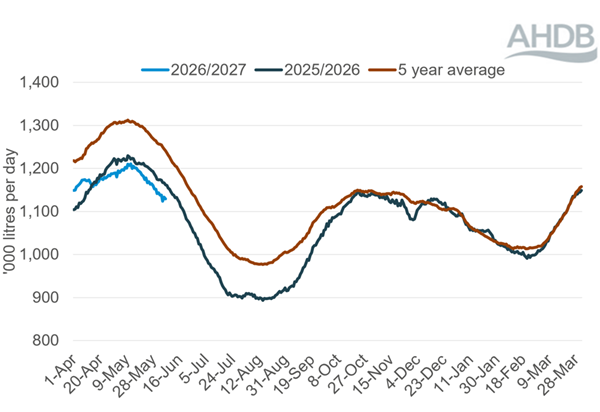
Organic GB milk deliveries have been behind year-ago volumes since May 2026. Defra's figures show a further decline in organic dairy cow numbers. Strong demand for organic milk, though processing capacity is limited, constraining the market. Organic deliveries show a weak flush
Figure 1. GB daily organic milk deliveries (7 day rolling average)
Source: AHDB
Last year, GB organic milk deliveries showed year-on-year growth from March 2025. Similarly to overall deliveries, good dairy economics supported growth, despite low forage stocks and quality. Anecdotal reports indicate that some organic farmers used derogations to supplement their organic supply during the drought.
Deliveries dipped into year-on-year decline from May 2026 and have remained well below the 5-year average. Milk year to date (April to 6 June) volumes are now 1.1% lower, year-on-year, whilst calendar year to date (January to May) is 4.7% ahead.
The recent dip has shown a similar trend to total milk volumes, albeit with a weaker spring flush.
Although farmgate prices have not dropped to the same extent of conventional averages, rising input costs are pressuring margins. In addition, grass growth (to which organic production is generally more closely linked to) has not been as strong as average. Forage stocks are also in tight supply due to the poor season last year.
Organic cull cow numbers are in short supply, creating incentives for sales and pressuring cow numbers.
According to Defra's UK organic farming statistics for 2025, total organic farmland (including in-conversion) hectarage increased by 7% year-on-year, in the UK to 540,000 hectares. Area in-conversion increased significantly, by 63%.
However, organic livestock numbers mostly declined. Dairy cows registered as organic (not including in-conversion) saw a decline to 46,000 head, from 48,000 head in 2024 (-4%), which is a steeper decline than total dairy cow numbers. Organic dairy livestock numbers were not the only category to decrease and total livestock producers reduced by 5% in 2025 compared to the previous year.
An increase in permanent pasture indicates a move toward more extensive land uses, likely in conjunction with environmental schemes. However, transitioning to organic farming is a significant long-term shift in production system. Farmers highlight that the suspension of the Sustainable Farming Scheme (in March 2025) and changing requirements for farmers reduced confidence in long term planning.
Recent organic farmgate prices have held better than the average conventional prices. For March, the average UK farmgate price was announced by Defra as being 35.05ppl, down 9.81 pence year-on-year, whereas organic contract movements have been less drastic.
Despite the pressures for downward pricing, organic farmgate milk price stability is likely a strategy used to hold onto long-term producers. In terms of margins, the premium will need to remain high enough to retain producers to keep pace with rising production costs.
Read the full article: Organic dairy update: Strong demand but do we have the resources to meet it? | AHDB
|
|
|
UK - Dairy June forecast update: GB milk production to ease
GB milk production for the 2026/27 season is forecast to decline to 12.91bn litres, 0.9% lower than the previous milk year according to our June forecast update
The past 2025/26 milk year reached record highs supported by favourable dairy economics. Now milk volumes have begun to ease and the current milk year (2026/27) has started with a year-on-year decline in milk deliveries to dairy processors. In the current year, deliveries to date (April to 13 June), were down by 0.9% compared to the same period in the previous year.
The declining GB milking herd, volume management control schemes, a decline in the number of GB producer numbers, rising input costs and declining milk-to-feed-price-ratio (MFPR) are the major factors behind the drop in milk deliveries.
Farmers could be facing winter pressures in cash flows considering low milk s ear and rising input costs. In addition to that, many will be hit with a bumper tax bill following the last year of high milk cheques. Though the war could see a ceasefire (although how lasting this will be is uncertain), the impacts on input costs will continue to be felt throughout the year.
Herd Size: Cow numbers continue the declining trend, with the size of the GB milking herd in April 2026 2.0% lower than a year earlier. The GB milking herd totalled 1.59 million head as of April 2026, another lowest number recorded, and a 2.0% decline compared to the same month the previous year.
Producer numbers: In our latest survey of major milk buyers, it is estimated that there were 6,850 dairy producers in GB as of April 2026. This is a substantial reduction of 160 producers (-2.3%) which was estimated since our last survey in October 2025. Looking at year-on-year changes since April 2025, there was an estimated decline of 190 producers (-2.7%) indicating that the majority of the industry exits took place last winter.
Favourable cull cow prices (above 5-year average despite recent pressure) and continued inflationary pressure on key input costs incentivised some producers to exit the industry as farm margins tighten.
Milk prices: In the latest milk price announcements for June and July, prices are mostly holding steady to firm but remain below the COP for many. Coming price announcements will depend on how demand is able to absorb the excessive stocks in the wholesale markets, both domestically and on a global level.
Read the full update: Dairy June forecast update: GB milk production to ease | AHDB
|
|
|
UK - Herefordshire dairy seeks £47k lifeline
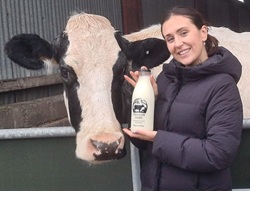 A Herefordshire organic dairy is seeking public backing to build its own milk processing operation after losing the buyer that had collected its milk for 25 years. Wicton Farm, home to Wild Cow Dairy, is trying to raise £47,000 to bottle and process its milk on site, saying the move would allow the business to remain independent.
The farm said it had been left with a stark choice after its buyer ended the agreement: stop dairy farming or process and sell all of its milk itself.
It said the business had been considered too small, with its "values and farming methods no longer fitting [with] the industrial dairy model".
Wicton Farm has a herd of 50 cows, which are 100% grass-fed and milked once a day. The farm said the cows live "a slower, more natural lifestyle", with calves staying with their mothers. It describes itself as "a certified organic, antibiotic-free farm working with nature to help create a healthier and more secure local food system".
The farm has now launched a fundraising campaign to adapt the business and continue operating independently.
It has set a deadline of 1 August to raise the £47,000, with the aim of completing the project by Christmas 2026.
https://www.farminguk.com/news/herefordshire-dairy-seeks-47k-lifeline-after-losing-25-year-milk-contract_68678.html
|
|
|
UK - Mackie's chairman recognised in King's Birthday Honours
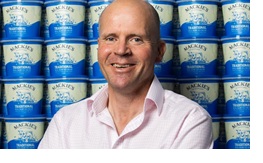 Award comes as iconic Scottish ice cream maker celebrates 40 years of success
Recognition been given to one of Scotland's leading rural entrepreneurs after he was awarded an OBE in the King's Birthday Honours List 2026. Maitland "Mac" Mackie has received the honour for services to farming, business innovation and sustainability. The award comes in a landmark year for Mackie's of Scotland as the family-owned business celebrates its 40th anniversary of making ice cream.
Taking over from his father as Managing Director in 1998, Mac has overseen the business' transition from a traditional dairy farm and milk business to its producing more than 15 million tubs last year, while ensuring that the brand remains committed to quality, sustainability and its farming heritage.
The award follows four decades of innovation and investment, during which Mackie's has become a recognised leader in sustainable food production, the best-selling ice cream brand in Scotland (WorldPanel, Premium Ice Cream, Volume) and the fastest growing ice cream brand in the UK for the past four years running. Building on the foundations put in place by his father, Mac spearheaded the company's commitment to sustainability, which now sees it renewably produce more than twice as much energy as it uses, through its wind turbines and solar farm.
Mac has ensured the company adapts to suit its rural location, modernising the farm to cater for increased production, installing packaging production facilities on site to reduce transport miles and introducing a low-carbon refrigeration system to improve the quality of the ice cream, while reducing emissions.
Maitland Mackie OBE, Chairman of Mackie's of Scotland, said: "This honour is a tremendous privilege and one that reflects the efforts of many people over many years. What the business and farm have achieved has only been possible because of the dedication of our customers, colleagues and family, who have supported us throughout the journey.
|
|
|
UK - Nominations Open for 2026 Dairy Industry Woman of the Year Award
Nominations are now open for the 2026 Dairy Industry Woman of the Year Award, celebrating women who connect, inspire and share knowledge across the British dairy sector.
Sponsored by HSBC and organised by Women in Dairy, an initiative of the Royal Association of British Dairy Farmers (RABDF), the award recognises women making a significant contribution to the dairy industry and championing its future. Now in its 10th year, the award is a key part of Women in Dairy's mission to bring women together through discussion groups, networking opportunities and industry events.
Previous winners have included farmers, vets, consultants and cheesemakers, with last year's award going to vet and farmer Claire Whittle. Nominations should reflect the core values of Women in Dairy: building connections, inspiring others and sharing knowledge and experience.
Laura Barber, Events & Membership Lead, said: "There are so many talented and inspirational women working throughout the dairy industry, helping to drive progress, innovation and excellence. "This award is an opportunity to celebrate their achievements and give them the recognition they deserve. Nominees do not need to be dairy farmers. They may be vets, consultants, researchers, technicians or professionals working elsewhere in the dairy supply chain. What matters is the positive impact they have on the industry and those around them."
Nominations close on 24 July 2026. Shortlisted finalists will be invited to attend an interview with the judging panel before the winner is announced at the Cream Awards at Chesford Grange, Warwickshire, on 3 September.To nominate yourself or someone you know, and to find out more, visit https://rabdf.co.uk/women-in-dairy/

|
|
|
|
| |
BRITISH DAIRYING
ENSURE YOU RECEIVE EVERY COPY
British Dairying is available by subscription at £70.00 posted to UK addresses,
£90.00 for Europe, £115.00 for the Rest of the world
or £30 +VAT for British Dairying Online only
|
|
|
QUOTE
"If you truly love nature, you will find beauty everywhere."
Vincent van Gogh - Post-impressionist painter, 1853-1890
"All good things are wild and free."
Henry David Thoreau - Naturalist, poet, philosopher, 1817-1862
|
|
| |
|
|
|
You are receiving this email because you are a registered reader of British Dairying and we are pleased to send you extra information to supplement the journal.
|
|
|
British Dairying, Grove House Media LtdPriory Cottage, Eastbourne Road Ridgewood East Sussex TN22 5STGrove House Media Ltd is registered in England and Wales, Registration No 16722598 Us
|
|