|
|  |
|
August 11, 2026
|
|
UK - Dairy retail performance - 11 July 2026
During the 12 weeks ending 11 July 2026, cows' dairy continued to be in volume growth, increasing by 0.5% year-on-year, while spend grew by 3.2%.
High spend was driven by average prices increasing by 2.7%¹.
Heatwaves across parts of the UK have reduced milk output. If the situation continues, shoppers may face higher prices and reduce promotional activity.
Cows' milk
Milk volumes declined by 1.0% year-on-year, around 8.7 m litres. This was possibly due to average prices increasing by 3.9% and as a result, spend increased by 2.9%.¹
Volume declines were seen for semi-skimmed and skimmed.
Plant based also declined in the period, losing 1.0% litres year-on-year.
Whole milk continued to see volume growth, with a 1.4% increase year-on-year. Other cow milk was in growth this period, with volumes up 10.5%.¹
Cows' cheese
Cow cheese benefited from lower average prices (-1.2%), encouraging shoppers to buy an extra 2.8 million kg and driving volume growth of 2.8% year-on-year.¹
The rise in volumes also supported value growth, with spend increasing by 1.6% year-on-year. ¹
Other cow cheese (+12.4%), snacking (+5.4%) and speciality and continental (+3.3%) were the main drivers of overall cow cheese growth. Within other cow cheese, cottage cheese remained the standout performer, with shoppers purchasing an extra 1.9 million kg year-on-year.¹
Despite accounting for 43.2% of all cow cheese volumes, cheddar volumes declined by 0.7% year-on-year. This was driven mainly by lower purchases of mild grated cheddar, mild cheddar and sliced mild. However, mature cheddars bucked the trend, with extra mature, sliced mature and block mature seeing the greatest volume increases.¹
¹ NIQ Homescan POD, Total GB, 12 w/e 11 July 2026
Read more on butter, yogurt and cream: Dairy retail performance - 11 July 2026 | AHDB
|
|
|
|
|
UK - How has this year's drought affected farming?
From crop production and livestock management to fire prevention and disease risks, many farmers are feeling the effects of the drought first-hand.
Potential straw shortages
Shorter cereal crops may result in less straw being available this season, raising concerns about supply later in the year.
Livestock producers, particularly those who rely on straw for bedding, may need to assess their requirements early and consider securing supplies early or exploring alternative options.
Forage supplies under strain
Grass growth has slowed dramatically in many areas, with some pastures stopping growth altogether.
As a result, some livestock farmers have already started feeding forage normally reserved for winter, raising concerns about feed availability later in the year.
With more hay and less silage being produced in some areas, the nutritional quality of available forage will need to be a consideration for winter livestock diets.
Heat stress in livestock
The prolonged heat is also affecting animal welfare. Dairy cattle, in particular, can be vulnerable to heat stress, which can reduce feed intake, impact fertility and lower milk production.
Providing adequate shade, ventilation and access to clean drinking water remains essential during periods of hot weather.
Bluetongue risk remains high
Warm temperatures have also created favourable conditions for the midges that spread bluetongue virus. Cases continue to rise, particularly in southwest England, and outbreaks remain a concern across Great Britain.
Farmers are encouraged to speak to their vet about vaccination to protect their animals, and stay informed about the latest guidance and advice. Vigilance and prompt reporting of suspected cases is vital to stopping the disease.
Whether dealing with drought, flooding, heatwaves or disease and pest pressures, building resilience is increasingly important for long-term business success.
By understanding risks, planning ahead and taking practical steps to prepare for a changing climate, farmers can put themselves in a stronger position to cope with whatever conditions future seasons may bring.
AHDB's Climate resilience on-farm action planner helps farmers identify climate-related risks, assess vulnerabilities and develop practical action plans for their businesses.
Read the full article: How has this year's drought affected farming? | AHDB
|
|
|
|
|
UK - Second cut averages confirm forage quality
Initial analysis of second cut grass silages by Trouw Nutrition GB confirms that dairy farmers should be more optimistic about increasing production from forage this coming winter.
With over 2200 first and second cut samples now processed through the company's laboratory in Ashbourne, Ruminant Nutritionist Isabelle England believes farmers can have confidence in the robustness of the data as an average.
"With milk price and feed price pressure still a major concern, the chance to produce more from forage will be welcomed, but it will be vital to have the true picture of the forages on farm when formulating rations," Ms England emphasises. "Weather conditions this summer mean that we are seeing regional variances and of course maize and subsequent grass cuts still have to be made. But initial indicators are encouraging."
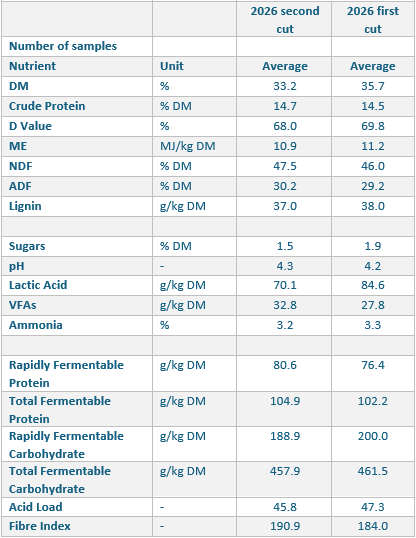
First cuts are generally showing encouraging nutrition characteristics with higher dry matter, ME and crude protein levels. Rapidly Fermentable Carbohydrates are higher, indicating a greater supply of readily fermentable rumen energy, and may support microbial protein production and milk from forage potential. NDF levels have decreased slightly, likely driven by earlier cutting dates. The reduction in fibre should help support higher intakes and higher forage inclusion rates provided stocks are sufficient and rations balanced accordingly.
"Overall, this year's first cuts, on average, appear nutritionally better than in recent years which will be encouraging for diet formulation." Ms England says the results for second cuts reflect the challenging season, with growing and harvesting conditions varying considerably across the UK. In some parts of the country the dry conditions will have restricted growth and encouraged producers to delay harvest to build yield. In other parts of the country, wet conditions at harvest affected wilting times.
"We are seeing a wide range in dry matters in second cuts, which will have practical consequences. At the wetter end of the range they may be a greater risk of effluent, more extensive fermentation and reduced dry matter intake. At the drier end, the issue will be effectiveness of consolidation leading to an increased risk of heating and aerobic spoilage so care at feedout will be essential."
On average dry matters have increased slightly at 33.2% which is lower than the average for first cuts. Despite a small increase in NDF, digestibility remains good and ME is averaging 10.9MJ/kgDM. As both digestibility and ME content are lower than average for first cuts, moving from first to second cut may reduce overall energy density in the ration unless other ingredients are adjusted to compensate.
"Looking at how second cuts will ferment in the rumen, RFC are slightly lower, indicating a reduced supply of rapidly fermentable carbohydrate compared with first cut. However, Total Fermentable Carbohydrates remain reasonably strong, meaning overall second cuts could provide a good base within the ration.
"Second cuts on average will provide a slightly greater supply of fermentable protein relative to fermentable carbohydrate which means the amount and degradability of protein in compounds and blends needs careful review. Adding additional degradable protein may therefore be unnecessary in some rations, increasing feed costs without improving performance, although the whole ration protein supply and quality must still be assessed."
She emphasises the importance of regular analysis of all clamps, ideally every 4-6 weeks, or whenever there is a noticeable change in the clamp face, to ensure the ration reflects the quality of silages actually being fed. This will be even more important when a wider choice of silages is available including later grass cuts, wholecrop and maize. Dry matters should be checked more frequently, and intakes should be monitored closely.
"The national averages indicate that there could well be the opportunity to increase forage intakes and the contribution from forage to reduce purchased feed costs this winter on farms with sufficient stocks and well-preserved silages to help support margins. But the skill will be in understanding the forage available on the farm and monitoring performance to maximise the opportunity," Ms England stresses.
TrouwNutrition
|
|
|

Visit CowManager at UK Dairy Day - September 16th
Want to detect health issues earlier, improve breeding results, and save valuable time on your dairy farm?
Stop by Booth H219 at Dairy Day and discover how CowManager helps you manage your herd more efficiently.
The CowManager Ear Sensor combines ear temperature with eating, rumination, and activity data to deliver highly accurate, early alerts. This unique combination enables you to identify sick cows days before clinical signs appear, detect heats with confidence, and make proactive management decisions that improve herd performance.
Our newest Innovation: Need to find a specific animal quickly? CowManager's Find my Cow Flash functionality makes it easy.
The sensor's built-in LED can be activated directly from your app or desktop, allowing you to instantly identify cows, heifers, or calves-even in large groups.
It's a simple feature that streamlines daily routines and helps your team work more efficiently.
With our Find My Cow tools, you can reduce time spent searching for animals, minimize lock-up time, lower labor costs, and improve the accuracy of everyday herd management. The result is greater efficiency, better animal care, and increased profitability.
Whether you're looking to optimize workflows, enhance animal health, or maximize the potential of your herd, CowManager provides the insights you need to make informed decisions.
Visit us at Booth H219 during UK Dairy Day and see how smarter monitoring can transform your herd management.
|
|
|
UK - Assess maize crops now for harvest readiness
Farmers are being urged to get into fields and assess maize crops for readiness considering current hot, dry conditions could bring harvest forward by 2-3 weeks.
Although there's huge crop variability depending on location, Amanda Clements from Volac says the summer's record-breaking heat waves mean every crop in England and Wales will likely be ready for harvest earlier than usual. "There's pressure to make the most of every tonne of maize considering grass silage stock are already low because of the drought. Plus, some missed the window to make wholecrop cereals due to rapid maturing during the heat," she explains.
"Maize growing costs are also high at around £600-900/acre and it's unlikely to be a bumper year, so the focus should be on routinely assessing crops to ensure they're harvested at the right time to optimise nutritional value and clamp fermentation." She advises the following:
Don't harvest by calendar and get into fields to assess the crop
Don't assess crops from the road, get out of the cab and into the field. "With the heat, you've got to keep your fingers on the pulse as crops can quickly reach maturity," Ms Clements says. "Get away from the headland and check the crop every other day from mid-August. That time input is nothing considering the crop's value. Generally, you see about a 2% uplift in dry matter per week, but that can accelerate to 6-8% in hot conditions so every day counts when aiming for optimum maturity."
Look at 10 representative cobs
Take 10 representative cobs from 3-4 different locations across the field, about 15-20 rows from the headland and away from tramlines. Peel the leaves back from the cob and push a nail into the kernel halfway down. It should feel like soft cheddar, which will give you a few days' grace with harvest. If you can't get a nail in, it's too late.
"Snap the cob in two and assess the milk line," Ms Clements adds. "Ideally, a quarter of the kernel should be pale and milky, and a third dark yellow or converted to starch. This will be around 30-35% dry matter, which is optimum for digestibility."
Check the maize plant
Look at the plant itself. There should be some die-back on the lower leaves, but the upper leaves should be green. If the plant is brown, it's been left too late. Take 10 plants and snap them in two. Ideally the plant should feel spongy. Be aware that in newer varieties, the cob can be ready, even if the leaves are green.
Use a silage additive to safeguard crop quality
It is likely that crops will be drier, which means they will be harder to consolidate in the clamp, raising the risk of heating and nutrient losses. The "sweet spot" is around 30-32% dry matter, anything over that will increase dry matter losses at the clamp shoulders and reduce starch digestibility and thus ration efficiencies.
Ms Clements says the fact there's been no rain also means the crop hasn't had a good wash and there could be higher levels of bacteria and moulds. "You need fermentation to drive a rapid drop in pH in the clamp and preserve crop nutrition, but the fermentation process needs moisture," Ms Clements explains. "That's where a heterofermentative additive, like Ecocool can help you take control of that process by producing lactic acid to drive efficient fermentation and a rapid drop in pH to help stop the proliferation of undesirable bacteria. Acetic acid production also helps to knock most yeasts and moulds on the head or make it a difficult environment for them to thrive, helping to prevent heating at feedout."
For more information on best practice maize ensiling, visit cuttoclamp.com
|
|
|
US - Dairy industry approaching threshold of fewer than 20,000 farms
Reporting by Dairy Herd Management highlights a comprehensive new report from agricultural analytics firm Terrain warning that the US dairy industry is rapidly accelerating toward a historic milestone: fewer than 20,000 dairy farms by the end of the decade. Since 1992, the country has lost more than 100,000 dairy operations - averaging an annual decline of about 5% - leaving just 23,609 licensed dairy herds remaining as of 2025.
Despite this steep and continuous reduction in farm numbers, US milk production has grown dramatically. In 2025, the national dairy sector produced 231.7 billion pounds of milk - a 54% increase over 1992 output - achieved with roughly 190,000 fewer cows and nearly 108,000 fewer farms. Highlighting this trend, Dairy Farmers of America observed that the industry is losing dairy farmers rather than production capacity, leaving remaining producers facing vast opportunities amid strong global demand.
The concentration of production is starkly reflected in USDA census data: half of all US dairy farms operate with fewer than 100 cows, yet those small operations account for only 4% of total milk sales. Conversely, mega-dairies with 2,500 or more cows represent just 4% of farms but command 45% of total milk sales. Senior dairy analyst Ben Laine notes that these surviving operations are larger, geographically shifted, and utilize fundamentally different technologies and management strategies than their predecessors. Read full story:
en.edairynews.com/u-s-dairy-industry-approaching-threshold-of-fewer-than-20000-farms/
|
|
|
Russia - Dairy industry hit by falling prices and weaker investment
An oversupply of raw milk pushed farmgate prices down by 23% during this period, leaving processors with mounting inventories and a drop in profits, according to newspaper Kommersant.
Only 109 new dairy companies were registered in Russia between January and May 2026, which is 45% fewer than in the same period a year earlier, states data from business registry Rusprofile. The number of active milk production and dairy processing companies in Russia stood at 33,500 on 1 June, down 26.4% year on year, said the newspaper, citing publicly available data.
High borrowing costs, dwindling state aid: Industry executives attribute the slowdown in investment to a combination of weaker government support and persistently high borrowing costs.
The dairy industry has become significantly less attractive for new investments as subsidised lending has dwindled, Artem Belov, chief executive of Russia's National Union of Milk Producers Soyuzmoloko said. While dairy producers were able to secure preferential loans at annual interest rates of 2-3% several years ago, they now face rates ranging from 6.3% to 9.1%.
According to Andrey Kucherov, director of the agribusiness competence center at Rexsoft Consulting, investment activity is increasingly concentrated among large, vertically integrated producers with the financial capacity to withstand the downturn.
However, even those companies are becoming more cautious, according to Kommersant. One of Russia's largest dairy producers, Ekoniva, for example, said it had been forced to put some investment projects on hold because of challenging market conditions.
Oversupply in the market: The Russian market is also heavily hit by the supply-demand imbalance. Russian market analysts estimated that the average farmgate price for raw milk in April was 23% lower than a year earlier. Meanwhile, dairy producers continued to face rising operating costs, with production expenses increasing by 6-16% over the same period. Read full story:
www.foodagribusiness.world/dairy/russia-39-s-dairy-sector-oversupply-and-investment-issues
|
|
|
UK - Using rumen-protected fats to protect milk production as grass quality declines
 As grass quality declines through late summer and autumn, maintaining energy supply without disrupting rumen balance becomes one of the biggest nutritional challenges facing grazing dairy herds. While mature pasture generally contains more structural fibre, supporting butterfat production, declining grass quality, lower dry matter intakes and reduced energy density can steadily erode milk yield if rations are not adjusted. However, seasonal changes in grass composition can create further nutritional challenges.
According to Dr Richard Kirkland, Global Technical Manager for Volac Wilmar Feed Ingredients, flushes of leafy regrowth later in the grazing season can trigger similar rumen responses resulting in butterfat depression as seen in early turnout periods. "Throughout the end of the summer, the oil concentration in grass begins to increase as it comes out of the reproductive heading phase. The result is a leafier, higher-oil grass that can trigger a similar rumen response to early-season pasture," says Dr Kirkland. "Being prepared with an appropriate feeding strategy helps minimise the impact on milk quality."
Protecting rumen function should remain the priority when supplementing grazing cows. "Late-season grazing isn't simply about adding more energy," says Dr Kirkland. "It's about delivering enough energy to maintain milk production without compromising rumen health. Once rumen function is disrupted, feed efficiency falls and performance quickly follows."
As pasture digestibility declines, many herds require buffer feeding to maintain energy intake. However, Dr Kirkland warns that increasing cereal inclusion too far can create further nutritional challenges.
"High-starch feeds ferment rapidly, increasing acid production in the rumen and lowering rumen pH," he explains. "That can reduce fibre digestion, increase the risk of subacute acidosis and ultimately compromise both milk yield and milk fat production." To maintain balance, Dr Kirkland recommends increasing dietary energy density with rumen-protected fat supplements, which are not fermented in the rumen and deliver concentrated energy directly to the small intestine.
"Rumen-protected fats provide around 2.5-times the energy density of cereals without adding to the rumen acid load," says Dr Kirkland. "They allow producers to increase energy supply while maintaining fibre digestion and rumen stability." Research also demonstrates the benefits of strategic supplementation. In grazing trials at the Tasmanian Institute of Agriculture's Dairy Research Centre, cows supplemented with 250 g/day of Megalac rumen-protected fat produced up to 2.1 kg of additional milk at peak lactation and maintained up to 1.5 kg/day additional response at 200-days in milk, while maintaining high fertility.
With energy supply becoming increasingly limiting as grazing conditions deteriorate, he believes rumen-protected fat should form a key part of late-season buffer feeding strategies.
"As grass quality and availability decline, buffer feeding with rumen-protected fat supplements helps meet energy demands without compromising rumen function. Combined with good grazing management, they allow producers to maintain milk production, protect milk quality and support herd performance right through to housing."
VolacWilmar
|
|
|
UK - Staying vigilant when recruiting
Whether you're advertising for a full-time role, taking on a summer student or offering work experience, bringing new people onto the farm is an important investment. Most applicants are genuine and enthusiastic about working in the dairy industry but carrying out a few simple checks before offering access to your business can help protect your farm and give you peace of mind.
NFU and AHDB guidance highlights the importance of having a clear recruitment and vetting process for prospective employees, students and work experience candidates. Asking for references, confirming previous employment and, where appropriate, checking directly with colleges or universities can help verify an applicant's background before they arrive on farm.
It's also worth considering who will have access to different areas of the business. Ensuring new staff are inducted properly, understand farm protocols and are supervised appropriately during their first weeks can help protect both the individual and the business.
The same common-sense approach applies online. Be mindful of how much information about your farm, family and business operations is publicly available through websites and social media. Limiting personal contact details and sensitive information can help reduce unwanted activist attention.
Most importantly, trust your instincts. If an application contains inconsistencies, references cannot be verified or something simply doesn't feel right, take the time to investigate further before proceeding. Genuine applicants will be happy to answer additional questions and provide supporting information.
A robust recruitment process doesn't need to be complicated, but it can help ensure you find the right people for your business while protecting your farm, livestock and staff. As with many aspects of dairy farming, a little preparation upfront can prevent much bigger issues later on.
NFU members can contact CallFirst for individual expert advice on best practice when recruiting new staff on 0370 845 8458.
|
|
|
UK - How to make the most of high protein silage
This year's grass silage is very high in protein, meaning producers could save money by using lower protein concentrates over the winter. But it is also extremely variable, so it will be essential to analyse it and balance diets carefully, says Robin Hawkey, senior nutritionist at Mole Valley Feed Solutions.
"On average, protein contents are at 15% compared to 13.8% last year," he explains. "That's a big jump." The highest samples are at 27.8% against 21% last year - and the extremes continue in other areas, too. Although the average neutral detergent fibre (NDF) is 46.4% compared to 47.4% last year, the lowest analyses are at 32.4% versus 38.6%. "The averages hide a really big range."
Dry matter contents are similar, year-on-year, at 36.3%, with metabolisable energy (ME) averaging 10.9MJ/kg and sugars 1.9% - but ranging from 0.2% to 9.5%. And the lactic acid is a lot higher at 77.3g/kg versus 74.5g/kg last year - within a range from two to 166.9g/kg. If high acid combines with a lower NDF, it will upset the rumen bugs, and will need to be buffered, warns Robin.
In order to meet these varied needs, Mole Valley has launched a new range of lower protein concentrates, which will also help farmers to comply with processors' demands for improved feed efficiency and carbon footprints. "Traditionally, cake is formulated at 18% protein," notes Robin. The new SilageMax range is 16% protein and comes with two options: Low Acid (LA) Boost and High Acid (HA) Balance.
SilageMax LA Boost should be fed with restricted fermentation (low lactic acid) silage, to provide energy to the rumen bugs, boosting fermentation and so producing more propionate from the rumen, which is important for energy supply. The feed contains wheat, beans, maize gluten, sunflower and rumen-protein rapeseed. "As rumen function could be restricted, it contains higher levels of rumen-fermentable protein and energy to drive microbial activity and microbial protein production," explains Robin.
In contrast, SilageMax HA Balance provides a counter to 'fast and fizzy' silage which is likely to lower rumen pH and pass straight through the cow. It contains soya hulls to boost fibre, palm kernel, maize grain as a form of bypass starch, and soya and rumen-protected rapeseed as bypass protein, alongside and an acid buffer; Acid Buf. In addition, it has X1 live yeast to promote fibre-digesting bacteria that are particularly sensitive to pH.
"The aim is to keep the high protein silage in the cow and utilise it," says Robin. "We have a whole range of cakes for mid-range silage - but where it's testing at either end of the spectrum, these options will really help you get the most from your forage." Producers who are feeding last year's maize silage may find it has higher lactic acid and lower pH than when it was first analysed, he warns. "It could be very different - silage that tested at 64% lactic acid in November is now at 68%, so it may benefit from adding HA Balance."
Both cakes also contain biotin which is beneficial for hoof strength, longevity and liver function, adds Robin. "It helps the liver enzymes to produce glucose. The liver is responsible for making use of the nutrients available, so we want to make sure it's functioning as effectively as possible.
www.moleonline.com
|
|
|
|
| |
BRITISH DAIRYING
ENSURE YOU RECEIVE EVERY COPY
British Dairying is available by subscription at £70.00 posted to UK addresses,
£90.00 for Europe, £115.00 for the Rest of the world
or £30 +VAT for British Dairying Online only
|
|
|
QUOTE
"You can spend the entire second half of your life recovering from the mistakes of the first half."
Saul Bellow, Seize the Day, Author, 1915-2005
"Act as if what you do makes a difference, it does."
William James, Philosopher and Psychologist - 1842-1910
|
|
| |
|
|
|
You are receiving this email because you are a registered reader of British Dairying and we are pleased to send you extra information to supplement the journal.
|
|
|
British Dairying, Grove House Media LtdPriory Cottage, Eastbourne Road Ridgewood East Sussex TN22 5STGrove House Media Ltd is registered in England and Wales, Registration No 16722598 Us
|
|