|
|  |
|
June 2, 2026
|
|
UK - Latest Recommended List delivers boost to grass and clover performance
Eleven new grass and clover varieties have been added to the latest Recommended Grass and Clover Lists (RGCL), offering dairy, beef and sheep farmers improved options for productive, resilient forage. This year's additions include Italian hybrid and perennial ryegrasses and a new diploid red clover. A further three lucerne varieties have also been added to the descriptive list.
To make the list, varieties must deliver a clear improvement on key traits such as yield, quality and disease resistance. Only a small proportion meet the standard each year, underlining the strength of the latest additions. The RGCL is the only fully independent source of UK trial data for farmers in England and Wales, helping underpin confident seed choices. Trials are overseen by the British Society of Plant Breeders with final selections made by the NIAB Herbage Recommended List Crop Committee, an expert panel representing farmers, merchants and the wider industry.
Plant breeders continue to make steady gains in forage performance, particularly in resilience. Recent improvements include better winter hardiness, higher ground cover and enhanced disease resistance in both ryegrass and clover varieties. Protein content in red clover has also increased, supporting higher-quality forage for livestock systems. Varieties not on the Recommended List may be older, outperformed options or may lack the robust trial data needed for fair comparison.
Cheshire dairy farmer John Hocknell welcomed the updated lists: "I refer to the Recommended Lists every year when making choices for my seed mixtures and work with my merchant to select the best varieties for my dairy system. I particularly value the fact that the data comes from robust independent trials that compare varieties from all breeders in traits that are vital to my business. I especially look for yield and digestibility to maximise performance from forage, both grazed and ensiled."
Heather McCalman, AHDB's Lead Grassland, Forage and Crop Nutrition Specialist, added: "In the light of rising input costs and volatile markets, the continual development of forage varieties in yield, quality and resilience traits has never been more important to dairy, beef and sheep farmers. There are varieties to suit all systems of cattle and sheep, and all have been scrutinised independently to meet exacting and increasing standards of performance."
Find out more about RGCL on the AHDB website
|
|
|
|
|
UK - Time to feed nutrients not numbers
 Dairy cow nutrition needs place a greater importance on the supply of key nutrients to ensure rations are meeting the correct requirements of the modern dairy cow, according to Dr Andrew Pine, Technical and Commercial Manager at UFAC UK. Commenting on current UK dairy cow diets Dr Pine stresses, "It's important for dairy farmers to urge their feed advisors to focus on nutrients, such as starch, sugar and NDF in their dairy cow rations, rather than just the sum of 'theoretical' Energy (ME) values provided by individual raw materials.
"Those feed advisors still adding up the sum of feed energy contributions have the additional problem for fat supplements of whether to use the ME number suggested by the manufacturer or apply a more realistic value that their 'head and heart' knows to be true," he explains. A really good example of this is the energy value allocated to commonly used palm-based calcium soaps. "In the UK, calcium soaps are often listed with an ME value in excess of 33 MJ/kg DM, which when fed at 0.4kg/head should provide enough energy for nearly 2.5kg milk. However, under farm conditions many feed advisors acknowledge this real response to the additional energy to be only 1-1.5kg at best."
So, what is behind this significant difference in response? An evaluation of these apparent differences was recently undertaken at the University of Nottingham. Cows from the University herd, already averaging 40kg milk/day, were offered rations containing either 0.5kg of a palm-based calcium soap or a high Oleic acid (C18:1) 50% fat supplement. "The results of the study were startling, as the high Oleic acid supplement, Envirolac, generated an extra 1.6kg Energy Corrected Milk (ECM) with higher fat and protein %," he reports. "There was also a tendency for higher TMR intakes, significantly improved feed efficiency and a reduced ration, as well as a milk, carbon footprint reduction of 11%."
From this study, the lead researcher Professor Garnsworthy concluded that the suggested energy value of the calcium soap at 33.3MJ/kg DM is substantially overestimated and that the real value may be closer to 23.8 MJ/kg DM. Furthermore, the Nottingham research confirmed that the high Oleic acid supplement out-performed their proposed energy values, and their effective ME contents can be considered to be as high as 29 MJ/kg DM.
Dr Pine concludes, "When thinking of fat supplements, focusing on the provision of key fatty acids in the correct ratio, and in the ideal form, is a better approach for achieving the most efficient and effective ration for the modern dairy cow. This will have a dramatic impact on the cost of each MJ of energy supplied and, therefore the potential return on investment; an issue very much at the forefront of dairy farmers in 2026."
UFAC
|
|
|
|
|
UK - Act now to build herd resilience to heat stress
Focusing on feed management and cooling cows could help build herd resilience to heat stress and lower the chances of mastitis and lameness linked to endotoxins.
Heat stress is an ever-increasing problem for dairy cows, with heat events occurring earlier in the year and hitting new highs. This year, temperatures of 18C were achieved in March, with a high of 26C seen in London in April and the highest May temperature on record of 35.1C hit last week . . . and that's before the summer truly kicks into gear.
With heat stress occurring at temperatures as low as 18C, particularly if humidity is high, Peter van der Vegt, Volac's lead for Technical Services says it's vital preventative measures are put in place to protect yields and long-term cow health.
"A period of heat stress is often followed by a spike in lameness and mastitis a few months later, but it needn't be the case," he says. "The key is to understand the cause of health and productivity issues caused by heat stress. This stems around preventing the production of endotoxins, which are largely to blame for health issues that occur after a heat event."
Peter says a cow under heat stress will eat and ruminate less, which reduces saliva production. Panting also produces more carbon dioxide which further reduces her buffering capacity. She's also more likely to binge eat when the environment cools. All this increases rumen acidosis risk. Acidosis leads to a decrease in the rumen pH causing rumen bacteria to die. Gram negative bacteria then release components of their outer cell walls, called lipopolysaccharides (LPS), which are endotoxins.
"Stress also causes gaps to open between the cells lining the rumen and hind gut, and this can cause an influx of LPS into the blood," Peter explains. "LPS can settle in soft tissues like the hoof and teats resulting in lameness and mastitis. The immune system also fires-up to try and get rid of LPS, diverting energy away from milk production."
This leaky gut also raises the risk of mycotoxins entering the blood. Mycotoxins are produced by certain moulds which grow on bought-in feeds and silage. 776 animal feed and forage samples were tested in the UK & Ireland in 2025 as part of Volac's Mycocheck service, with 93.2% of those positive for one or more mycotoxin. These invisible toxins have wide-ranging effects including reduced feed efficiency, suboptimal fertility and lameness and mastitis due to their impact on the cow's immune system.
Peter says it's possible to reduce the impact of heat stress and protect the cow from endotoxin and mycotoxin challenges by optimising cow comfort and cooling cows.
"Ensure cows are provided with a consistent, well balanced, easily accessible ration to lower acidosis risk. That will be helped by providing plenty of feed space and pushing up regularly to optimise intakes. Also, speak to a nutritionist about adapting the diet in response to heat stress. This may mean raising the energy density by feeding a rumen-protected fat, such as Megalac. Cows low in energy balance will be more susceptible to endotoxins," he says.
He also urges farmers to incorporate the mycotoxin remediator and endotoxin binder, UltraSorb R into the ration in advance of hot periods so cows are better able to cope.
UltraSorb R is exclusively available through Trident MicroNutri and contains specially selected minerals to bind various mycotoxins and endotoxins; plus biological active agents to transform and detoxify the harder to bind mycotoxins. Yeast components also help to support gut health.
Peter believes taking a preventative approach will benefit staff time and herd performance. "Cows in need of your attention take up most of your time, so ultimately if you can have less mastitis, less lameness, it will free up time to spend elsewhere managing the herd," he says.
Volac
|
|
|
|
|
UK - Q1 2026 dairy trade review: export volumes continued to grow
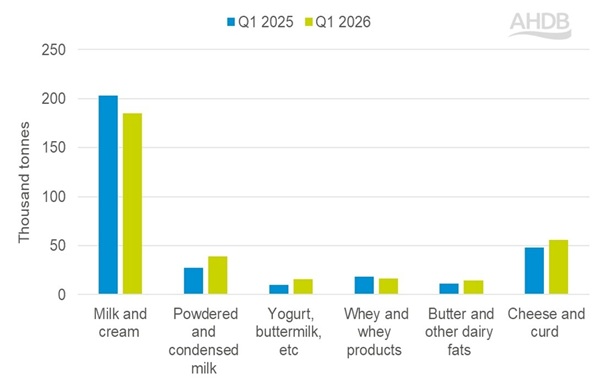
Key trends: Total UK dairy export volume for Q1 2026 increased 2% year-on-year at 326,000 tonnes driven by powders, yogurt, butter and cheese; Total UK dairy export value stood at £478 million, down 7% year-on-year, due to falling commodity prices; Total import volumes and value were up, driven by powders, yogurt and cheese; Total export volumes of dairy products from the UK for Q1 2026 increased 2% year-on-year driven by non-EU exports which increased by 9,000 tonnes. Exports of dairy products to the EU declined by 1,400 tonnes probably due to strong milk supplies and production in the EU region.
Figure 1. UK dairy products exports, Jan-Mar (Thousand tonnes)
Source: HMRC compiled by Trade Data Monitor LLC
Figure 1 bar chart compares UK dairy export volumes (in thousand tonnes) across six product categories for Q1 2025 and Q1 2026. Each category shows two bars: blue for Q1?2025 and yellow green for Q1?2026.
UK dairy imports edged up
UK dairy imports increased by 1.5% (4,200 tonnes) to 291,400 tonnes in Q1 2026. Imports from EU nations increased by 1.2% (+3,200 tonnes) and imports from non-EU countries increased by 10.2% (+1,000 tonnes) mainly from Australia (+800 tonnes).
Total import changes by category included: Yoghurt: up 9,400 tonnes (12.7%); Milk powders: up 2,200 tonnes (11%); Cheese and curd: up 2,200 tonnes (2%); Whey and whey products: down 5600 tonnes (-25.5%); Butter: down 2,100 tonnes (-13.3%); Milk and cream: down 1,700 tonnes (-3.8%).
Imports from Greece saw the biggest increase (7,400 tonnes), followed by Spain (2600 tonnes), Switzerland (1800 tonnes), Denmark (1,500 tonnes) and France (1,000 tonnes). A growing appetite for proteins is fuelling imports.
Figure 2. UK dairy products imports (Jan-Mar, thousand tonnes) Source: AHDB
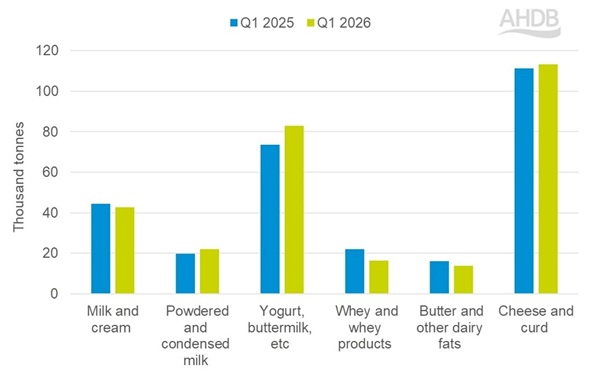
Figure 2 bar chart compares UK dairy import volumes (in thousand tonnes) across six product categories for Q1 2025 and Q1 2026. Each category shows two bars: blue for Q1?2025 and yellow green for Q1?2026.
Read more about the Dairy Trade Review on the AHDB website
|
|
|
Abbi New Generation: Abbifan 140-XXP-31
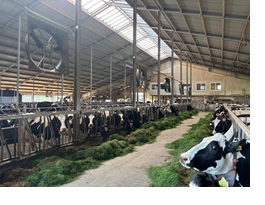 Taking performance, animal welfare, and environmental care to the next level
As a global manufacturer in barn ventilation, Abbi is proud to present the next generation of smart, sustainable ventilation systems: our Abbifan 140-XXP-31.
This new model is the direct successor of our widely respected XXP-21, currently the leading benchmark in mechanical ventilation. Independent testing (LfL, Bayerische Landesanstalt für Landwirtschaft, Grub - Germany) confirms its optimal airspeed and distribution, enabling cows to effectively release excess body heat into the ambient air - a critical factor in reducing heat stress.
Sustainable Design: Next level noise reduction - higher welfare
The new Abbifan retains all the proven benefits of its predecessor, but with a significant reduction in sound emissions. Animal welfare begins with a comfortable environment - and that includes acoustic comfort.
In the shared audible range (500-4200 Hz), humans and cows experience sound similarly. This includes continuous barn sounds like metal clanging from feeding barriers - often perceived as disturbing by both animals and workers. In typical dairy barns, average chronic noise levels range from 61 to 74 dB(A). Yet welfare studies show that levels above 70 dB(A) already negatively affect cow health and milk quality (increased somatic cell count), while levels above 85 dB(A) can lead to behavioral changes.
To combat this, we have developed a newly engineered motor strut, fully manufactured from recycled ABS with superior aerodynamic properties. This has enabled us to reduce operational noise by 2 dB(A) - from 58 dB(A) (steel strut) to an industry-leading 56 dB(A).
This reduction equals almost a 50% decrease in perceived sound volume - a substantial improvement for both animals and humans in the barn.
Sustainable Design: Minimal footprint, maximum circularity
Sustainability is no longer optional. With the 140-XXP-31, Abbi delivers a fan system designed for full lifecycle responsibility:
- The motor strut and orifice panel are made from recycled ABS.
- Approximately 50% of the fan's total material is plastic, of which 90% is high-quality recycled content (which is itself fully recyclable).
- The remaining 50% (steel, aluminium, copper) is 100% recyclable.
This means that almost the entire unit can be recovered and reused, drastically reducing environmental impact.
Sustainable Design: Extremely energy efficient
It is not only the investment in fans itself that counts but also the daily costs associated with it. This extremely energy efficient Abbifan 140-XXP-31 can easily provide savings of anywhere from £350.00 up to £500.00 per fan per year! With an energy consumption of only 0.53 kW at its highest setting as opposed to no less than 1.1 kW by the other fans on the market, this will lead to savings of £425.00* per fan annually. And if we increase the kW/h price by 3 pence, your savings can amount to up to £470.00 per fan each year!
Your return on investment is faster thanks to savings on your daily costs plus the maintenance costs you save on not having to replace bearings, belts, or pulleys.
* Based on an average price of £0.30 per kWh 13/6/2024.
|
|
|
UK - Tesco launches 2026 Agri-tech Challenge to help future-proof British farming
- Applications now open for the 2026 Tesco Agri-tech Challenge until Friday 3 July 2026.
- The competition is open to agri-tech innovators worldwide with solutions that can strengthen resilience across food supply chains.
- New two-pathway model will support both early-stage and scaling technologies with tailored mentoring, supplier introductions and potential real-world trial opportunities.
Tesco, in partnership with Leading Edge Only (LEO), the global innovation marketplace, has today opened applications for the 2026 Tesco Agri-tech Challenge, which invites agri-tech innovators from around the world to submit solutions that can help farmers and suppliers build more resilient, sustainable and productive food supply chains.
Winners will receive support including direct access to Tesco's Sustainable Agriculture and Fisheries team, alongside fast-track introductions to relevant supplier partners.
The refreshed competition, previously known as the Agri T-Jam, aims to identify promising technologies that could help address some of the biggest challenges facing agriculture, from animal health and welfare to emissions reduction, soil health, biodiversity, automation, crop losses, food waste and on-farm quality. This year's Challenge will include two innovation pathways, recognising that agri-tech businesses need different types of support depending on their stage of development.
TRL (technology readiness level) 4-6 winner: Will receive specialist mentoring from a key Tesco supplier as well as help to refine their innovation within the relevant industry.
TRL 7 and above winner: Will receive the opportunity to trial their technology with one of?Tesco's supply chain partners. This will provide the platform for further development and growth within the designated sector(s). The winner will also receive feedback and mentoring from Tesco's Sustainable Agriculture and Fisheries team.
Both winners will be guided through the process by members of the Tesco Sustainable Agriculture and Fisheries team. Applications for the 2026 Tesco Agri-tech Challenge are now open and will close on Friday 3 July 2026. Applications can be submitted here.
|
|
|
UK - Separate slurry to manage phosphorus
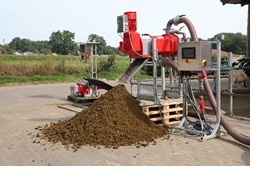 The pressure on farms to better manage phosphorus can be addressed using separation. So says Andy Hayhurst, from Vogelsang, who explains that separation is not just about reducing the strain on storage but can also be an important measure to reaching phosphorus management guidelines.
"Defra has clearly outlined its plans to reduce total nitrogen, phosphorus and sediment pollution from agriculture into the water environment by at least 40% by 2038. While the process has been slow to take hold, there are movements being made to put additional pressure on farms, especially those near rivers and watercourses," he says.
Using a separator such as Vogelsang's XSplit creates a solid fraction with approximately 40 percent dry matter. The majority of phosphorus in slurry is removed into this solid, making it more manageable. "Moving unseparated slurry costs more and, with the rise in fuel prices, fertiliser prices and the call from government to better manage phosphorus, there seems no better time to be taking advantage of separation technology," he adds.
Concentrating phosphorus in the solid fraction leaves the liquid fraction with nearly all the soluble nitrogen (ammonium, nitrates, nitrites) and potassium. This allows for different application rates for the solid and liquid fractions to better match soil and crop needs. It can also reduce the cost of transporting the phosphorus solids over greater distances.
"For farms with land spread over wider areas, there are significant cost benefits to managing phosphorus through separation. Similarly, farms with a variety of crops can better manage phosphorus application by top dressing with a solid fraction that is rich in phosphorus for crops and soils that will benefit, and using the liquid fraction in areas that could be more prone to leaching phosphorus," says Mr Hayhurst.
Recent extreme weather conditions in the UK have led to significant surface run off and soil leaching. By soil and slurry testing, farms can better understand the implications of slurry application to overloading fields that may, subsequently, pose a risk to nearby water.
"More accurate application is needed to improve soil health, make better use of natural and synthetic fertilisers and reduce the risk of phosphorus entering rivers and bodies of water. Separation is one way that farms can better manage slurry, understand it's nutrient value and apply it more efficiently to ensure soils and crops are receiving the optimal amounts of N, P and K," he concludes.
Vogelsang
|
|
|
UK - In-home dishes review: Health, value and simplicity are the new drivers
By Kim Heath, AHDB Lead Retail Insight Manager
Brits consumed 87% of their food and drink occasions in the comfort of their own home last year, according to Worldpanel by Numerator¹. However, the impact of inflation is clear, with this being 970 million fewer occasions than the previous year and with some consumers skipping meals completely. Out-of-home occasions are also struggling as many people are substituting eating out with carried out (i.e. lunchboxes, etc.). With fewer meals being consumed, it is even more integral to ensure red meat and dairy play a clear role when dining at home.
Three key trends are shaping in-home main meals:
Health remains a strong and growing driver; A shift away from pure convenience; A renewed focus on scratch cooking driven by affordability needs. These trends are closely linked, with rising costs encouraging consumers to cook more from scratch, which is also perceived as healthier.
What trends are impacting our in-home main meal choices?
Last year, for the first time since Covid, we saw a slight decline in the number of consumers choosing meals for speed and ease reasons (although both remain important). This is coupled with a slight increase in time spent preparing our meals, which on average is now 14.8 minutes for lunch and 33.7 minutes for an evening meal (Worldpanel Take-Home Usage by Numerator UK, 52 w/e 28 December 2025)
While assembled meals (items bought together and served on the same plate) still account for the majority of occasions in home (61.2%), we have seen a rise in scratch cooking. During 2025, 9.7% of lunch occasions (+1.1ppt year-on-year (YOY)) and 20.4% of evening meal occasions (+0.4ppt YOY) were scratch cooked. Its relevance is increasing as scratch typically represents a cost-saving option versus convenience options, being on average 82p cheaper per lunch meal and 58p cheaper per evening meal¹. Affordability is also reflected in meal compositions, with a shift towards fewer ingredients being used, despite 'ease' being less of a consideration.
Health as a reason for food choices has continued to grow to one of its highest levels in a decade. We predict health engagement will continue in 2026, bolstering scratch meals further as they are considered the healthiest type of meal. For more information, see our 2026 consumer health predictions.
Read the rest of this article on the AHDB website
|
|
|
|
| |
BRITISH DAIRYING
ENSURE YOU RECEIVE EVERY COPY
British Dairying is available by subscription at £70.00 posted to UK addresses,
£90.00 for Europe, £115.00 for the Rest of the world
or £30 +VAT for British Dairying Online only
|
|
|
QUOTE
"Don't underestimate the value of doing nothing, of just going along, listening to all the things you can't hear, and not bothering . . ."
A. A. Milne - writer and playwright, 1882-1956
|
|
| |
|
|
|
You are receiving this email because you are a registered reader of British Dairying and we are pleased to send you extra information to supplement the journal.
|
|
|
British Dairying,
Grove House Media Ltd
Priory Cottage, Eastbourne Road Ridgewood East Sussex TN22 5ST
Grove House Media Ltd is registered in England and Wales, Registration No 16722598
|
|