|
|  |
|
May 12, 2026
|
|
UK - Impact of Middle East war on dairy sector
AHDB has assessed how the escalating conflict in the Middle East is affecting the global dairy market and what it means for UK producers. Disruption to key shipping routes is driving up fuel, fertiliser and feed costs, adding further pressure to farm margins at a time of market uncertainty.
Key trends
- War in the Middle East is affecting the global dairy sector
- Iran is regionally important and also the fourth largest exporter of skimmed milk powder (SMP) globally
- Gulf Cooperation Council (GCC) countries are mainly import dependent to meet dairy requirements and a key growth area for British dairy exporters
- Strait of Hormuz closure has impacted trade flows and agricultural input costs
Overview
The recent escalation of the war involving Iran, Israel and the US has sparked volatility in the entire agricultural sector including dairy. This has resulted in supply disruptions and trade flows through the Strait of Hormuz and slowdowns via other routes. Due to this there has been an increase in fuel prices and fertiliser prices, thereby increasing input costs and pressurising farm margins.
This will have ripple effects across the dairy sector with long-lasting impacts. The situation differs from the outbreak of war in Ukraine when production was already tight. Globally, there has been excess production of dairy products following spectacular growth in milk production in 2025 which continued into 2026. Markets could be under further pressure with softening demand being unable to absorb the excess stocks.
Visit the webpage to find out more
|
|
|
|
|
UK - Farmers urged to plan ahead as bedding squeeze continues
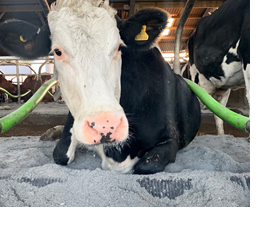 Livestock farmers are being warned to brace for continued high bedding costs and supply issues, as straw and hay prices are expected to remain elevated throughout 2026 and beyond.
According to AHDB, tight supplies, ongoing weather challenges and rising production costs are continuing to drive the market, with little sign of easing in the near term.
In its latest straw outlook, AHDB Senior Economist Jess Corsair said: "Wet weather at the start of 2026, tight straw supplies, reduced cropping areas and high contracting costs mean straw prices may stay elevated through 2026. It is likely that higher price levels for straw and hay could remain throughout 2026 and future years."
Further pressure is expected as cropping areas decline, with spring barley predicted to be down 15% in 2026 and winter barley also seeing a reduction, raising concerns over future availability.
The warning comes after two difficult harvests in 2024 and 2025, which saw wet weather impact both yield and quality. Wheat straw prices have already risen by an average of 20% year on year, with barley straw following a similar trend. At the same time, sawdust markets have tightened, with large volumes being exported for biomass production, leaving many producers struggling to secure sufficient, good quality bedding.
Liz Russell, of EnviroSystems, said demand for paper-based bedding is rising sharply. "We've gone from being a crisis solution to something farmers are actively choosing," added Mrs Russell. "EnviroBed isn't reliant on the weather, and in a year like this, and with global volatility, that security of supply becomes incredibly important."
She added that the current situation mirrors the conditions that led her to develop EnviroBed 25 years ago during the 2001 foot-and-mouth outbreak a development that saw it gain a Queen's Award for Enterprise and Innovation in 2006.
Poor bedding conditions can have serious implications for livestock systems, increasing the risk of mastitis, lameness and wider welfare issues, ultimately impacting both productivity and profitability.
With demand from GB farmers continuing to rise, EnviroSystems has secured new contracts with paper mills to ensure a consistent supply.
As weather volatility and supply pressures persist, industry figures are urging farmers to plan ahead and consider alternative bedding strategies to protect herd health and business resilience.
EnviroSystems
|
|
|
UK - More farming co-operatives could 'unleash growth' in UK, finds report
Greater agricultural collaboration can improve food security and resilience to global crises, says policy paper. Agricultural co-operatives could "unleash growth" in the UK and improve national food security in the face of crises such as the Middle East conflict by "improving the resilience of UK farms", according to a report.
The policy paper produced by the Co-operative party, which backs influential Labour MPs including Steve Reed and Jonathan Reynolds, calls for "a shift in perspective, not a doubling down of the status quo". It says co-ops, which enable farmers to pool resources, share risk and invest collectively, can help "reduce exposure to volatile input markets", such as fertiliser, fuel and animal feed.
The report, seen exclusively by the Guardian says: "They create the conditions for shorter, more resilient supply networks, and for greater retention of value within rural economies. And in doing so, they align economic resilience with democratic ownership."
There are an estimated 526 agricultural co-operatives in the UK, generating an income of more than £9bn, including the Arla dairy group and Berry Gardens Growers. In 2019, about a half of UK farmers were estimated to be members of a co-operative in some form.
However, the report says there is "significant room for expansion" and that a forthcoming 25-year Farming Roadmap for England presents an opportunity for the Department for Environment, Food and Rural Affairs (Defra) to formalise a commitment to expanding agricultural co-ops.
Labour's 2024 manifesto included a commitment to "support diverse business models", including by doubling the size of the co-operative and mutuals sector. The call for change in British farming, which is being backed by the Co-operative Group, which runs thousands of grocery stores, comes amid concerns about the proportion of British food being imported.
Meat imports into the UK rose 15% year-on-year in 2025 to £5bn, according to HMRC data obtained by the Co-operative Group. Poultry was the most imported protein, worth almost £2bn, with imports from Poland and the Netherlands accounting for the largest share. Imports from Thailand soared nearly 50% on the previous year to £23.3m, about 1% of fresh and frozen poultry imports, indicating a growing presence in shopping trolleys and on dinner plates.
Across the national diet, the UK grows only 62% of what it consumes. The UK imports 83% of its fruit, for example, although this is partly because of the popularity of fruits that cannot be grown in the UK, such as bananas.
Rising fertiliser and food costs caused by the conflict in the Middle East have added to existing pressures on farmers from post-Brexit changes to subsidies and problems with exports, unpredictable weather amid the climate crisis and lower prices for their crops on global markets.
Joe Fortune, leader of the Co-operative party, said: "Cooperation is a form of strategic resilience. In a world where fertiliser supplies can be disrupted and energy costs can spike overnight, the ability to coordinate, adapt and invest collectively becomes a matter of national strategic importance. Government has the opportunity to unleash growth in this sector and use it to help secure our supply chains for the future."
TheGuardian
|
|
|
UK - Mission to build on record year for British dairy exports
The dairy sector has turned to the growing appetite for British produce in Asia to help build on last year's record export values.
Total UK dairy exports were worth £2.2 billion in 2025 - up 16.6% on the year, following our comprehensive programme of activity in 2025 to promote international trade development.
Building on this, we recently spearheaded a drive to develop further opportunities in Asia, which in 2025 accounted for £152 million of UK dairy exports, an increase of 14.2% on 2024.
We were joined by eight businesses on our biggest ever stand at FHA Singapore to promote world-class British cheese, butter and ice cream.
Events like this put British dairy directly in front of key buyers and decision makers in target export markets, moving British dairy from parlours in the UK to plates overseas.
The four-day event also attracted buyers from Vietnam, Malaysia, the Philippines and Hong Kong, who had the chance to taste produce being showcased and learn about how British farmers work hard to produce fantastic dairy products.
Following hot on the heels of FHA Singapore was an AHDB-led mission to Malaysia for six companies, which included around 60 meetings with buyers, updates on import protocols and visits to retailers.
Lucy Randolph, AHDB Head of International Trade Development, said: "It was a phenomenal week of activity for AHDB Dairy, with FHA Singapore creating a real buzz of interest in our world-class produce and the mission to Malaysia highlighting further opportunities for our exporters.
"The global appetite for our dairy exports was clearly demonstrated by last year's figures, and it's critical that we maintain a wide range of markets as we look to build on that success. Markets in Asia are an important part of that portfolio, reflected in our biggest ever presence at FHA and our targeted mission to Malaysia led by our in-market representative Karen Liao.
"It was great to see the commitment of our dairy businesses to exporting, and AHDB will continue to support them with resources to ensure British dairy takes pride of place in markets around the world."
The latest activity in Asia forms part of our programme of work to support the growth of dairy and red meat exports. This includes coordinating inward and outward trade missions, participation in major trade shows and work to help secure and maintain market access.
This month (May), attention will switch to Europe when we take part in Tuttofood in Milan, which will bring together exporters and buyers from around the world.
Read more about opportunities for dairy exports in our analysis Prospects for UK agri-food exports
|
|
|
UK - Hopes for quick market recovery dashed by volumes of milk
UK - Hopes for quick market recovery dashed by volumes of milk
The recovery in commodity markets seen in the first quarter of 2026 brought hopes for farmgate prices to increase accordingly and for margin pressure to ease. However, market signals have been mixed and, in April, fats markets lost much of the gains made showing recovery is still uncertain.
Figure 1. UK wholesale prices from early 2023 to April 2026
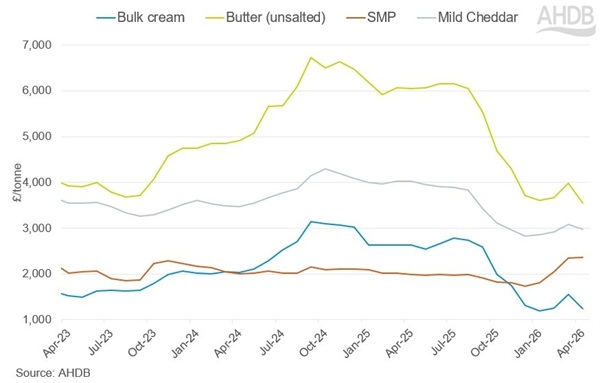
Figure 1 shows average UK wholesale prices from early 2023 to April 2026 for bulk cream, butter (unsalted), skimmed milk powder (SMP) and mild Cheddar, measured in pounds per tonne.
Butter prices remain consistently higher than the other products, although are now at the lowest levels seen in the period. All four products show a steep decline from late summer 2025 into early 2026, followed by modest recovery in February and March 2026 with butter, cream and Cheddar declining in April and only SMP seeing growth.
SMP shows the strongest improvement in early 2026 compared with the other products. Bulk cream remains the lowest priced product across the period.
Find out how markets have gone into reverse, the impact on farmgate prices, if the war in Iran playing a role and what farmers can do on the AHDB website.
|
|
|
DEADLINE APPROACHES . . . Cream Awards entries - please send your entry by 31st May . . .
Put yourself forward, or nominate someone you know. www.creamawards.UK
|
|
|
|
|
Health testing is not a luxury…
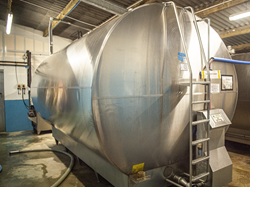 …it's smart risk management.
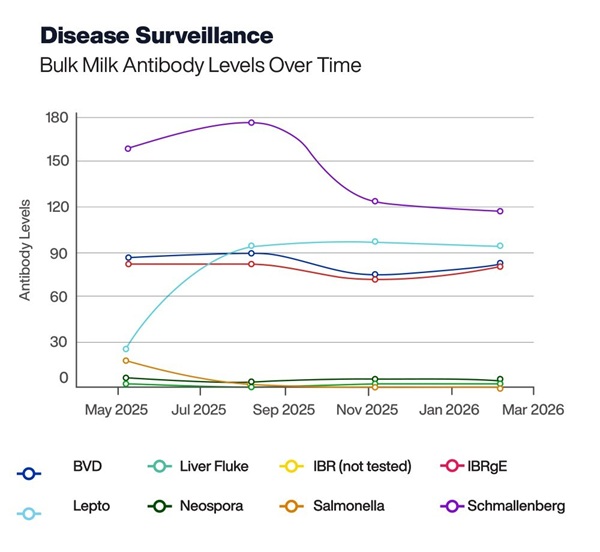
Time is one of the most valuable assets on any farm. Waiting for problems to appear, reacting instead of preventing, and dealing with unexpected disease outbreaks all come at a cost. Early disease detection gives you the power to act sooner, protect herd performance, and avoid costly surprises.
Use your bulk milk sample
You can use your bulk milk sample to test for infectious diseases. It's quick and simple and built around your routine.
With flexible testing options designed to suit your needs, NMR makes herd health monitoring easy - saving you time while keeping you in control.
Both NMR and non-NMR customers can screen their herd quickly, easily and cost-effectively for cattle diseases using their bulk milk sample or individual cow milk samples. Offering a convenient, robust, cost effective and non-invasive way to assess herd health.
Bulk testing for key diseases includes: BVD (antibody); BVD (qPCR Virus); Leptospirosis; Salmonella; Schmallenberg; IBR (gE & gB); Neospora; Liver Fluke.
Samples can be tested on a regular quarterly regime or on an ad hoc basis, for as many or as few diseases as required. It is best to discuss your requirements with your vet to assess which option best suits your herd. Results are accessed through Herd Companion and can be viewed by third parties if permitted; results can also be sent by email or post.
Individual cow milk samples can also be tested, as well as blood and tissue samples. Speak to us about bolting testing onto recording samples and for non-recording herds, simply let us know how many samples you would like testing and we will send you a sampling kit.
Don't wait for a problem to show itself. Every day you delay is time lost - and risk increased. *Well…97% of dairy farmers can do this!
For more information, please visit nmr.co.uk or call 03330 043043 National Milk Records | Health Testing
|
|
|
UK - AI tool aims to transform herbal ley measurement
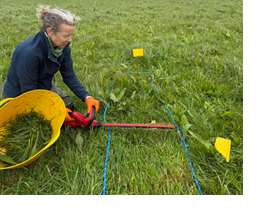 A farmer-led project funded through Defra's ADOPT programme is piloting a smartphone-based tool set to transform dry matter yield measurements of herbal leys and give livestock farmers a clearer understanding of pasture performance.
The multiple benefits herbal leys bring to productivity, soil health, biodiversity and improved resilience are well recognised, but there are few ways to measure the amount of feed available from them quickly and reliably.
Currently farmers with herbal leys rely on visual estimates causing inefficiencies in allocating grazing and feed budgeting with poor use of available forage and the potential for sub-optimal animal performance.
"Tools such as plate meters and satellite prediction models are calibrated for ryegrass but don't perform well on multispecies mixes," explained project facilitator Becky Willson. "This new tool combines videos taken by farmers in the field with a machine learning model to estimate grass yields and provide information able to improve the use of herbal leys and overall grazing management."
The new system is designed to deliver results in seconds, without requiring specialist equipment or internet connectivity, making it practical for everyday use on farm. It tells farmers how much grass they are growing within diverse mixes at different time points throughout the season.
The data helps build confidence herbal leys can perform well and be integrated into cropping rotations, and by making the most of their forage, farmers can reduce costs and improve profitability.
The trial is being carried out across a mix of dairy, beef and sheep farms in England to ensure the tool is robust across different grazing setups and soil types. "We started collecting pasture samples and matching them with the farmer videos at the beginning of April," continued Becky. "We have collected more than 500 pasture samples across eight farm sites, with the samples being processed in the lab to determine dry matter content and which can be used to train the model."
App-based predictions are being compared against traditional cut-and-weigh measurements, to validate the model and refine it for both accuracy and ease of use under real farm conditions.
The ADOPT programme supports farmer-led, on-farm trials addressing real-world challenges to generate practical, scalable solutions for the sector. Results from the project will be shared through on-farm events and industry channels as the work progresses.
|
|
|
UK - Feeding dry cows: The Goldilocks approach
Feeding dry cows correctly is a critical factor in dairy herd health, productivity and profitability, and there is a fine balance to be found, according to leading research. Speaking at a nutritional masterclass organised by Mole Valley Feed Solutions, Professor James Drackley of the University of Illinois highlighted the risks of overfeeding dry cows, even when body condition score (BCS) appears unchanged. This 'hidden overfeeding' can lead to metabolic diseases, reduced feed intake after calving, and lower milk yields at a time when dairy producers face increasingly tight margins.
Promoting what he terms the "Goldilocks" approach, Prof Drackley emphasised the importance of balance. "You want to provide 90-110% of cows' energy requirements consistently, and with adequate other nutrients," he said. The aim is to calve cows at a BCS of three, avoiding excessive energy intake throughout the dry period.
Research showed that cows fed 100% of their energy requirements outperformed both underfed and overfed groups, producing 29.7kg/day of milk in the first 10 days post-calving, compared to just 26kg/day in overfed cows. Overfeeding also resulted in insulin resistance, reduced dry matter intake (DMI), and increased risk of subclinical ketosis.
Further findings showed that controlling energy intake can significantly reduce health risks, including a fivefold decrease in displaced abomasum and a 2.1-times lower risk of ketosis, while also shortening time to pregnancy by 10 days. "It's a win-win," Prof Drackley noted.
High-energy diets increase visceral fat deposits, which release inflammatory compounds known as cytokines. These contribute to chronic inflammation, impaired liver function and weakened immunity. "Modest overfeeding could lead to a >75% increase in visceral adipose tissues that drain directly to the liver."
Alongside energy management, updated guidance on protein nutrition suggests significantly higher metabolisable protein (MP) requirements, particularly for close-up cows. "Close-up cows will need a 13% (7.8% MP) crude protein diet - but might need more," said Prof Drackley.
Attention is also turning to amino acid balance, particularly lysine and methionine. Supplementation in rumen-protected form has been shown to increase milk yield by up to 2kg/day and improve milk fat and protein content. Research commissioned by Mole Valley Farmers demonstrated that targeted feeding strategies with rumen-protected amino acids can deliver measurable financial returns. Improvements in milk components translated into an additional £60/cow over 12 weeks after calving, delivering a 2:1 return on investment.
Dr Chris Bartram, Head of Nutrition at Mole Valley Farmers, said the findings have already informed new product development. "As a result of this research and work with James, we have developed a bespoke new feed range for feeding both pre and post calving," he said. With metabolic health, milk quality and profitability closely linked, the message is clear: Achieving the right nutritional balance during the dry period is essential for modern dairy success. www.moleonline.com
|
|
|
UK - Greater understanding needed to achieve food security
Farming and the rural business sector are under tremendous pressure right now - and need careful, balanced policies if they are to remain viable. That's according to the Central Association of Agricultural Valuers (CAAV), which recently hosted 80 influential guests from across the sector in a bid to foster greater understanding of the issues being faced.
"There was a real range of discussions and a lot of quiet diplomacy," says Jeremy Moody, Secretary and adviser to the CAAV. Food security is an immediately pressing issue, with arable farmers in particular operating with long-term losses and facing soaring costs due to the Gulf war. "That has taken 20% of the supply of almost everything off the world's markets; higher costs will affect every sector. We need the Government to be aware of the implications, and to consider whether farmers should become a priority for access to fuel."
"Discussions ranged from compulsory purchase to farm productivity, and environmental issues to inheritance tax," says Mr Moody. Guests also chatted about artificial intelligence, valuing land for renewable energy, access to labour and the threats from the Government's proposal to transfer rule making for the food chain to Brussels.
"Rural land is changing faster than many realise," says Paulo Barros Trindade, Chairman of The European Group of Valuers' Associations (TEGOVA), who came over from Portugal. "It is adapting to structural shifts in land use, energy policy and generational change. And valuation must change with it. Ensuring that valuers remain central to these transformations is more than a professional responsibility: It's a matter of market integrity."
Change is also an opportunity, says Julie Liddle, President of the CAAV, who hosted the event. "It's where you need trusted advisers to deliver whatever that opportunity is." Fostering understanding and exchanging knowledge with the wide range of people who are impacted by - or have influence over - the rural sector is therefore vital. "We're trying to make the profession more visible to more people - as well as using our Route to Rural campaign to attract new entrants to the sector. It's an exciting time." www.caav.org.uk
|
|
|
UK - Address inconsistent nutrition at turnout to avoid issues
Spring turnout is one of the biggest nutritional transitions of the year for dairy herds and can lead to several challenges for the herd. However, small changes in the management at turnout can significantly reduce any negative impact on performance.
"After months of consistent winter diets, cows are suddenly exposed to fresh grass, changing dry matter intakes, and rapidly shifting rumen conditions," explains Andrew Pine, Technical and Commercial Manager, UFAC UK.
"So, although fresh grass brings opportunity for dairy herd performance, it also brings risks, including dips in milk yield and butterfat, disrupted rumen stability, and a loss in cow condition, especially for high-risk groups such as high-yielding cows, fresh cows and early lactation animals.
"These issues are rarely caused by poor grass, however. More often, they are simply the result of a sudden change in diet," Andrew adds. "And that is something that can be addressed."
There are several key areas to look at that often influence performance at turnout, according to Andrew, which are critical to the transition. "Introducing grass progressively allows cows to adapt more smoothly. Many farms begin with short grazing periods and build up over time.
"Maintaining effective fibre intake is also important, as it helps support rumen stability and reduces the risk of milk fat depression, particularly in high producing herds.
"Although fresh grass can be high in energy, intake can be inconsistent. Wet conditions, variable covers and grazing behaviour all influence how much cows actually consume. With a dry matter of only 20%, for cows to consume 15kg dry matter during their allocated grazing time requires them to consume 75kg of fresh grass, which during wet conditions can be a bit of a challenge. This means energy supply can fluctuate from day to day, which makes it harder for cows to maintain peak performance and body condition," he explains.
"Cows that maintain intake and performance during turnout are more likely to sustain production through the grazing season, so it is worthwhile to adjust the nutrition to ensure intakes if necessary.
"Early intervention helps prevent longer-term performance losses at turnout. Ensure you closely monitor herd performance during the first few weeks to help identify early warning signs. Milk yield, butterfat, dung consistency, and cow behaviour all provide useful indicators. Get turnout right, and it sets up the rest of the season. Get it wrong, and performance can take weeks to recover," he warns.
UFAC
|
|
|
UK - New cheese from Cwmbran Usk Valley Cheese Company
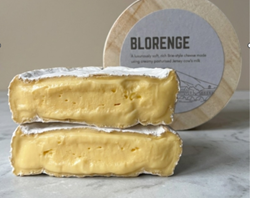 The Usk Valley Cheese Company, based in Cwmbran, has launched Blorenge, a Brie-style cheese made using Jersey cow's milk sourced from Abergavenny. Crafted in small batches, the new addition is the company's first foray into soft cheeses.
Ethan Parry, of Usk Valley Cheese Company, said: "We wanted to create a cheese that celebrates the quality of local ingredients and the richness of Jersey milk."
Blorenge is named after The Blorenge, the hill that overlooks Abergavenny. The cheese is made with milk from Josh's Jerseys, a nearby farm. Mr Parry said: "At Usk Valley Cheese Company, we believe in provenance. "The milk for thee cheese comes directly from Josh's Jerseys in Abergavenny, several miles away from our micro-dairy in Cwmbran. This close connection ensures the highest quality milk and reinforces the link between our cheese and the Usk Valley it celebrates."
The company also produces Chartists' Heritage, Roman Gold, and Six Peaks, all of which are Gouda-style cheeses. Josh Morgan, owner of Josh's Jerseys, explained the farming approach behind their high-quality milk. He said: "Our herd is pasture-fed, grazing outside on grass for most of the year. We operate a closed herd, breeding our own young stock, which keeps generations of cows together throughout their lives." Blorenge is available now through selected farm shops, delis, and the company's online shop.
SouthWalesArgus
|
|
|
|
| |
BRITISH DAIRYING
ENSURE YOU RECEIVE EVERY COPY
British Dairying is available by subscription at £70.00 posted to UK addresses,
£90.00 for Europe, £115.00 for the Rest of the world
or £30 +VAT for British Dairying Online only
|
|
|
QUOTE
"We have two ears and one mouth, so we can listen twice as much as we speak." Epictetus - Greek Philosopher - 135AD
"Courage is what it takes to stand up and speak, courage is also what it takes to sit down and listen."
Sir Winston Churchill - British statesman, 1874-1965
|
|
| |
|
|
|
You are receiving this email because you are a registered reader of British Dairying and we are pleased to send you extra information to supplement the journal.
|
|
|
British Dairying,
Grove House Media Ltd
Priory Cottage, Eastbourne Road Ridgewood East Sussex TN22 5ST
Grove House Media Ltd is registered in England and Wales, Registration No 16722598
|
|